
24 Sophisticated Coffee Table Decor Ideas to Copy Now
Good coffee table decor is the difference between a living room that looks finished and one that looks paused mid thought. The table sits in front of every guest, holding drinks, books, and first impressions all at once, so it quietly grades the whole room.
These 24 ideas build one calm styling system: a clear table, one anchor, groups of three, safe candles, and zones that survive family life. In my experience, you do not need new furniture or a decorator’s budget; you need order, height, and a few honest pieces placed with intention.
Start with the first idea tonight, and let the table set the tone for everything around it.
Start With a Clear Table and One Anchor Piece

Great coffee table decor never starts with shopping; it starts with an empty table and one honest look at the space. Clear everything off, wipe the surface, and sit on the sofa to see the table exactly as your guests will see it every single night.
Then choose one anchor piece, the tray, the book stack, or the bowl that everything else will gather around, and place it slightly off center. In my experience, that single decision stops the table from collecting random objects all week long afterward and keeps styling simple.
Style in Groups of Three, Never in a Row

Rows make a table look like a shop shelf, while small groups make it look styled by someone with taste. Three objects of different heights, sharing one color or material, give the eye a complete little picture to rest on before moving across the table.
- Pick the tallest piece first, usually a plant, a vase, or a candle holder, and set it at the back of the group.
- Add a medium piece beside it, lower by at least a hand, in a color the tall piece already carries.
- Finish with one low, wide piece in front, like a small bowl or a short stack of books.
- Step back to the doorway and check the group reads as one shape, then adjust the gaps with two fingers of space.
Also View: 24 Christmas Decor Ideas for Living Room Sweet Warmth
Build a Triangle of Heights on the Table
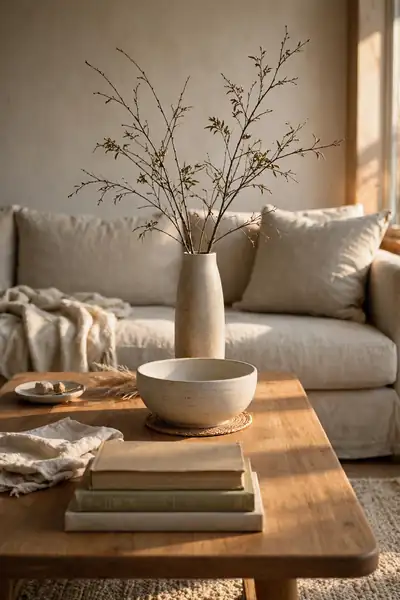
Quick Tip: Photograph the table from the sofa with your phone before you finish. The camera flattens heights honestly, and a broken triangle shows up on screen long before your eye catches it in the room.
Heights work when the tallest piece stands near one end, a medium piece sits lower toward the middle, and the lowest piece rests at the front edge. That falling line leads the eye across the whole table. Keep one hand of space between levels so each height reads clearly.
Anchor Everything on One Tray That Fits the Table

Common Mistake: Choosing a tray by its looks alone, then finding it swallows the whole table or fits only two objects, so everything else crowds around its edges anyway.
The Fix: Measure the table first and pick a tray that covers about one third of the surface, leaving the other two thirds open for cups, feet, and daily life.
A rightly sized tray works like a picture frame, telling every small object where it belongs and where it may not go. I’ve noticed tables stay tidy for weeks once the tray sets that border. Choose a raised edge if drinks share the table often at your house.
Also Explore: 22 Christmas Decor Ideas That Feel Like Pure Magic
Stack Books in Twos and Threes and Top Them Once
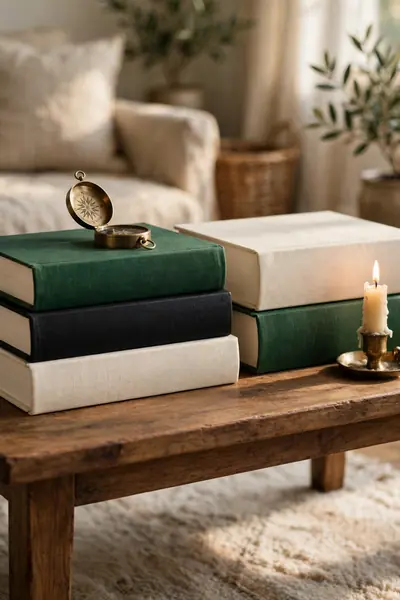
What You Need:
- Large hardcover books, wider than paperbacks, with clean covers
- Two or three books per stack, never more than four
- One small heavy object to top a stack, like brass, stone, or ceramic
- A soft cloth to dust covers and the table first
Books earn their place when the stack itself looks chosen, so group books by cover color and turn every spine the same way for one calm block. Keep the top object small enough to lift with two fingers. Guests should be able to open the top book without dismantling your styling.
Choose Greenery That Survives Indoors
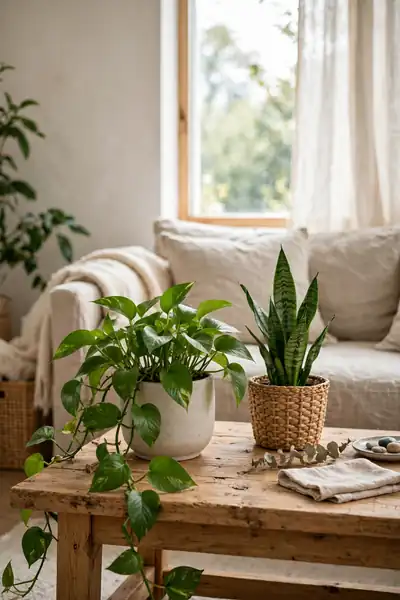
Before: The table holds a plant that needed daily sun and weekly fussing, so within a month its yellow leaves became the first thing guests noticed about the whole room.
After: A tough pothos or snake plant in the same spot keeps its green for months on one watering a week, and the table looks cared for instead of quietly failing.
Coffee tables sit far from windows in most rooms, so choose plants that forgive low light rather than plants that demand it. Water on one fixed day, and turn the pot a quarter each week for even growth. A plant that thrives beats a dramatic one that slowly dies.
Save Fresh Flowers for Weekends and Guests

Do This:
- Buy one small bunch and split it into two tiny vases instead of one tall arrangement.
- Set the flowers where they are seen from the doorway, not hidden behind the book stack.
- Change the water every second day and trim the stems once, so the bunch lasts the whole week.
Avoid This:
- Do not buy a large arrangement that forces everything else off the table.
- Do not keep flowers past their drooping point, because tired flowers date the whole room.
- Do not place strong scented blooms where people eat snacks or rest their heads.
Fresh flowers are a short, bright event, not a permanent fixture, and treating them that way keeps them special instead of sad. On plain weeks, a green plant or a bowl of fruit does the same job quietly. Save the flowers for when eyes will actually be in the room.
Layer Natural Texture With Wood, Stone, and Woven Pieces

Cost: Low to Medium | Time: 30 minutes | Skill Level: Beginner | Best For: Rooms that feel flat or cold
Texture is what the hand and eye read as expensive, long before color registers. Mix one rough piece, one smooth piece, and one woven piece, and the table gains depth without a single new color entering the room. Keep the mix to three textures so it stays calm, not busy.
Group Candles at Safe Heights on a Tray

Candles scattered one by one around a table look like leftovers from a power cut, while candles grouped on one tray look like a decision. Set three heights together, tall at the back and small at the front, so the flames form one warm pool of light.
The tray is the safety system, catching drips and keeping every flame on one steady, heat safe surface away from book edges. Light the group only when someone stays in the room. Battery candles give the same glow on nights when nobody can watch them.
Give the Table One Bowl That Actually Catches Things

Every home has small things that wander: keys, sunglasses, mail, the other remote. A beautiful bowl that nobody uses is a missed chance, while a bowl with a job keeps the table clear and still looks like the most elegant thing on it.
- Choose a bowl wide enough for a hand to reach into easily, with a weight that will not slide when keys land in it.
- Place it near the edge of the table people reach first when they walk in, not in the styled center.
- Give it one rule: only things that get picked up again today may land there, everything else goes to its real home.
- Empty it fully once a week, on the same day, so the catch-all never becomes a junk drawer with better looks.
Add One Sculptural Piece and Give It Breathing Room
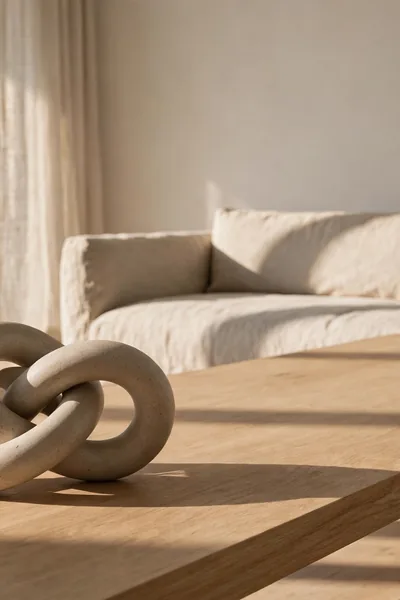
Quick Tip: Set the sculptural piece down, then remove one other object from the table before you judge it. Space is the frame that makes a single strong piece look expensive, and most tables need subtraction, not addition.
A sculptural piece works the way a painting does: one clear shape the eye can study without competition. Choose a form with a shadow worth looking at, in ceramic, stone, or wood. In my experience, guests touch this piece and ask about it more than anything else on the table.
Place One Personal Piece Where It Stays Safe

Common Mistake: Setting the framed photo or the fragile keepsake at the front edge of the table, where elbows, cups, and children reach it first and it slowly gets damaged.
The Fix: Give personal pieces the back corner near the sofa arm, raised on a book stack if needed, where eyes land on them often but hands rarely knock them.
Personal pieces are what separate a styled table from a showroom table, because they carry a story no shop can sell. One is enough; two start competing, and three become clutter with feelings. Rotate a single piece each season, and the table keeps telling new stories all year.
Style the Lower Shelf Like a Second Small Table
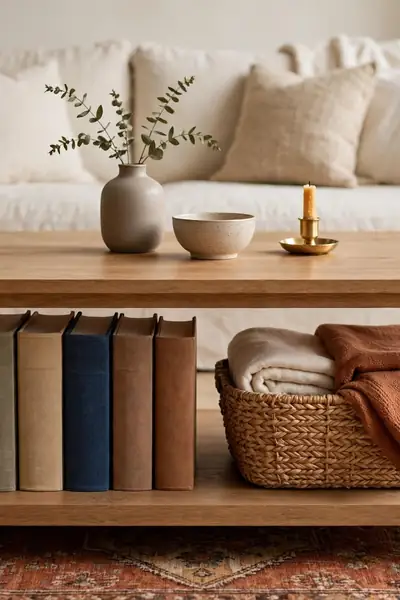
What You Need:
- One woven basket that fits the shelf height with a little room to spare
- Large books laid flat or stood in one short, tight row
- Folded throws or extra cushions stored where hands can reach them fast
- A small gap left empty, so the shelf never looks stuffed
The lower shelf is free styling space most homes waste on dust and lost remotes. Treat it like a second, quieter table: one basket, one book row, nothing random. I’ve noticed guests look down there more than we think, and a styled shelf makes a plain table feel twice as considered.
Keep a Working Zone for Remotes, Coasters, and Cups
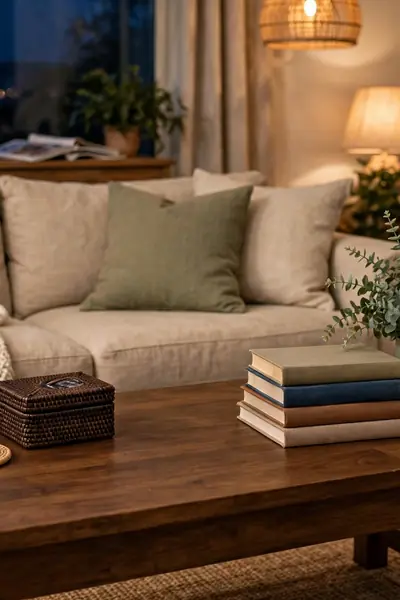
Before: The styling covers every inch, so the first evening with drinks and remotes pushes pieces aside, and within a week the whole arrangement collapses into everyday mess again.
After: One end of the table is left open on purpose, holding only coasters and a remote box, so daily life lands in its zone and the styled end survives untouched.
A table that fights daily life loses every single time, so give daily life its own legal space instead. About one third of the surface is plenty for cups, feet, laptops, and game nights. Style the other two thirds boldly, knowing they will never be asked to move.
Dress a Round or Glass Table With Soft, Low Pieces

Do This:
- Follow the circle: round trays, curved vases, and bowls that echo the table shape.
- Keep every piece low, because tall items on round tables tip the balance and block views across.
- Use a soft round textile under the group to protect glass and quiet the hard surface.
Avoid This:
- Do not line pieces along an imaginary edge, because round tables have no edges to follow.
- Do not load glass with heavy stone stacks that strain the surface and the eye.
- Do not crowd the center, because the see-through base needs empty space to feel light.
Round and glass tables reward softness and punish clutter faster than any other shape. One low group in the center, plenty of clear glass around it, and the table looks like floating art. From the sofa, you should see through the arrangement, not fight past it to find faces.
Dress a Rectangular Table in Two Zones
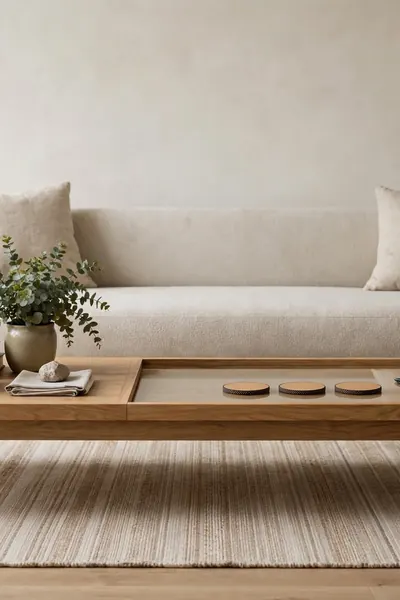
Cost: None | Time: 20 minutes | Skill Level: Beginner | Best For: Long rectangular tables in family rooms
Length is the rectangular table’s gift and its problem, because one long styling run looks like a runway nobody lands on. Two zones give the eye two landings: a styled end and a working end. A low, long tray down the middle can stitch both zones together quietly.
Go Monochrome When the Room Already Has Color
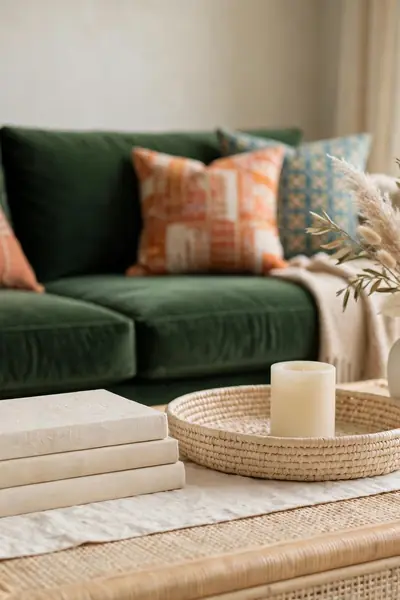
A room already full of color needs its table to stay quiet, because two loud voices in one space only argue. Shades of one color family, cream over ivory over warm white, give the eye a resting place and make the colorful furniture look richer by contrast.
Monochrome only works when the textures do the talking, so mix matte ceramic, glossy glass, rough weave, and smooth book covers inside the same pale family. Standing back, the table should read as one calm shape. Guests feel the calm before they can explain it at home.
Add One Pop of Color and Repeat It Once

One strong color on a neutral table is like one loud note in a quiet song: it carries the whole arrangement. The secret is not the color itself but the discipline after it, because the note must echo exactly once more in the room and then stop.
- Choose the pop from a color already living in the room, in a painting, the rug, or one cushion.
- Place it as one piece only: a vase, a bowl, or a single book with a strong cover.
- Repeat the same color once, in the same depth, somewhere the eye travels next, like a cushion or a throw.
- Remove any third item in that color, even a small one, because three stops being an accent and starts being a theme.
Mix In One Metallic Accent for Evening Shine

Quick Tip: Test the metallic piece after dark, not in daylight. One brass holder that looks shy at noon can throw warm light across the whole table at night, and two can start to look like a shop display.
Metal works by reflection, so a little performs like a lot once lamps come on. Keep the accent to one metal family, brass or silver, never both fighting on one small surface. Matte pieces around it give the shine something calm to bounce against in the evenings.
Break Symmetry on Purpose, Then Balance the Weight

Common Mistake: Copying the same group onto both ends of the table, candle for candle and book for book, until the styling looks like a mirror instead of a room.
The Fix: Style one side tall and full, the other side low and single, then check the balance by squinting: both ends should feel equally heavy even though nothing matches.
Symmetry is safe, but it reads as stiff in a room where people actually live and lean and talk. Uneven sides feel collected over time, like the table grew with the family. I’ve seen this work best when the two sides share one color, quietly holding the difference together.
Match the Table to the Rug and Sofa First

What You Need:
- One color or material borrowed from the rug, repeated on the table
- One tone borrowed from the sofa, in a bowl, book, or textile
- The room’s main metal, matched once in a small accent
- Nothing on the table that appears nowhere else in the room
A table styled in isolation can be beautiful and still feel wrong, because the room around it tells a different story. Borrow before you buy: two echoes from the rug and sofa are usually enough. Stand in the doorway afterward, and the table should look inevitable, not imported.
Shop Your Own Home Before You Buy Anything
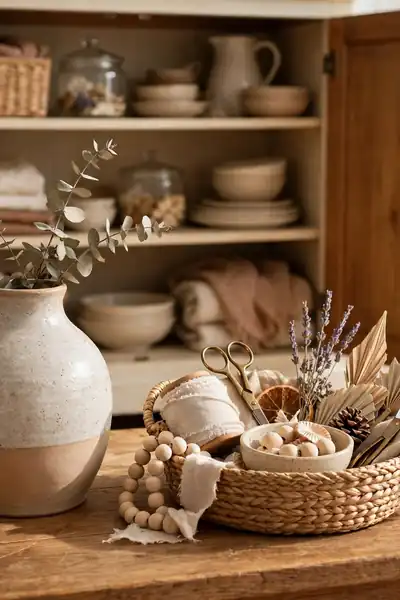
Before: The table feels tired, the cart at an online shop fills with new vases and trays, and the total climbs toward a sum the room never asked anyone to spend.
After: A walk through the home gathers a bedroom vase, a kitchen bowl, and a hallway book, and the table looks newly decorated by evening without one single purchase that day.
Every home already owns a second decor shop: its own shelves, cupboards, and spare rooms. Pieces moved from another room feel new because the eye meets them in a new place. I’ve tried this before every planned purchase, and half the planned purchases quietly cancel themselves.
Make It Safe for Kids and Pets Without Losing Style

Do This:
- Build the base from wood, woven, metal, and heavy ceramic pieces that survive knocks and curious hands.
- Keep anything breakable above child reach or behind the sofa line, on stacks in the back corner.
- Choose battery candles in the busy years, and save real flames for the shelf above the table.
Avoid This:
- Do not balance tall, top-heavy pieces near the edge where small hands pull and tails sweep.
- Do not use glass bowls or sharp edged trays while the table doubles as a play zone.
- Do not scatter small objects that fit in a child’s mouth, however pretty they look grouped.
Safety styling is not a pause in style; it is a filter that simply changes the materials, not the ideas. Groups of three, trays, and book stacks all still work in wood and weave. When the children grow, the glass and flame return, and the habits stay for good.
Refresh the Same Base With Small Seasonal Swaps
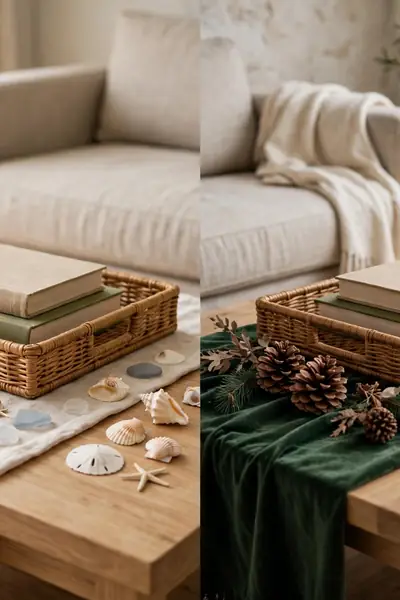
Cost: Low | Time: 15 minutes | Skill Level: Beginner | Best For: Keeping one styled base all year
A strong base should never be rebuilt four times a year, because rebuilding is where styling quietly falls apart. Keep the tray, books, and anchor exactly where they are, and swap only the soft layer: cloth, flowers, one bowl filling. Fifteen minutes, and the room believes in the new season fully.
Frequently Asked Questions
1. How many objects should sit on a coffee table?
For most tables, three to seven objects in total feels right, grouped together rather than spread out. One anchor, one group of three, and one low piece is a calm starting point. If the table still asks for cups and feet daily, fewer is always better.
2. What size tray works best on a coffee table?
A tray covering about one third of the surface works for most tables, leaving the rest open for real life. Round tables take round trays, long tables take long trays. Measure before you buy, because the wrong size is the most common styling purchase mistake.
3. How do I style a very small coffee table?
Small tables need one group only: a tiny plant, one book, and one small object on a small tray. Skip the second group entirely and let the empty edge do the styling. In my experience, a small table styled lightly looks bigger than a crowded one.
4. What can I use instead of fresh flowers?
A good faux stem, a green plant, a bowl of fruit, or a candle group all hold the spot well between flower weeks. Choose one and keep it for the whole season. Rotating the replacement weekly makes the table feel restless instead of fresh.
5. How high should the tallest piece on the table be?
Keep the tallest piece below the eye line of someone seated on the sofa, so faces stay visible across the table. Tall branches belong at the back corner, never in the center. If you must duck to talk, the piece is too tall or misplaced.
6. How do I keep the table styled when my family uses it daily?
Give daily life its own zone, keep the catch-all bowl emptied weekly, and return every piece to its group each night. A sixty second reset after dinner protects the styling better than any purchase. Styled tables survive families when the system is easy, not strict.
Conclusion
A sophisticated table is not bought in one order; it is built from order, height, texture, and a few pieces that truly belong to your life. Start with one idea this week, perhaps the tray or the group of three, and watch how the room answers. I’ve seen how making this one change, styling the table as a system instead of a surface, can completely shift the result from scattered to calm. Save these coffee table decor ideas on Pinterest for your next refresh, try one on your own table, and share them with a friend whose living room is waiting for the same quiet upgrade.




One Comment