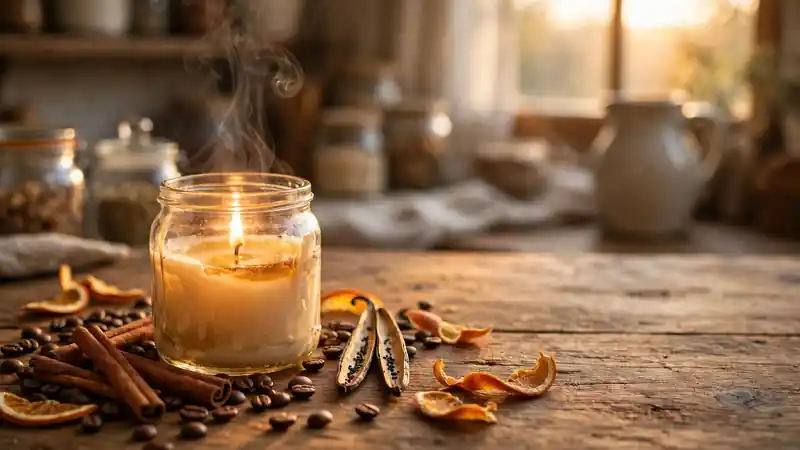
Scent Your Candles Beautifully Without Essential Oils
Your candle looks perfect, but when you light it, the room smells of almost nothing. If that sounds familiar, the oils in the wax are the problem. There are better ways to scent candles without essential oils, and most of them are in your kitchen.
I’ve noticed that beginners blame the wax first, when the real issue is that essential oils fade in heat and never had much throw to begin with. Fragrance oils made for candles, whole spices, coffee beans, and vanilla pods all hold up better, and each one works differently.
Why Essential Oils Often Disappoint in Candles

Essential oils smell wonderful in the bottle, which is exactly why their performance in a candle feels like a letdown. They are built from light, delicate plant compounds, and the heat of melted wax plus an open flame breaks many of those compounds down before they ever reach the room.
Cost is the second problem. A small bottle of pure lavender oil can cost more than a whole bag of wax, yet still give a faint result. Add the batch-to-batch variation in natural oils, and your favorite candle is hard to repeat exactly, which frustrates beginners and sellers alike.
Safety Rules to Settle Before You Add Anything
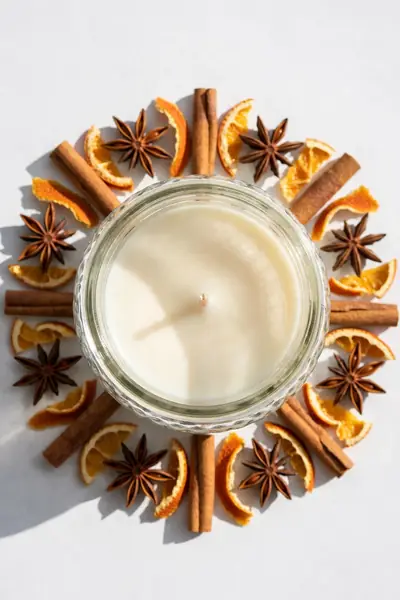
Pantry ingredients feel harmless because we eat them, but a candle is a flame sitting in a pool of hot wax. Dried spices, herbs, and peels can catch, smolder, or clog a wick if they sit in the wrong place. These four rules keep every method in this guide safe.
- Use only fully dried ingredients. Fresh peels and herbs hold water, which makes hot wax spit and leaves sinkholes around the wick.
- Keep every visible piece at least an inch away from the wick, pressed near the edges of the jar where the wax melts last.
- Never leave a candle with botanicals burning unattended, and place it away from curtains, paper, and anything that can catch.
- Trim the wick to about a quarter inch before every burn, so the flame stays small and the melt pool stays controlled.
Also View: Candle Wax Measurements Made Super Simple for Beginners
Every Supply With the Exact Size and Quantity
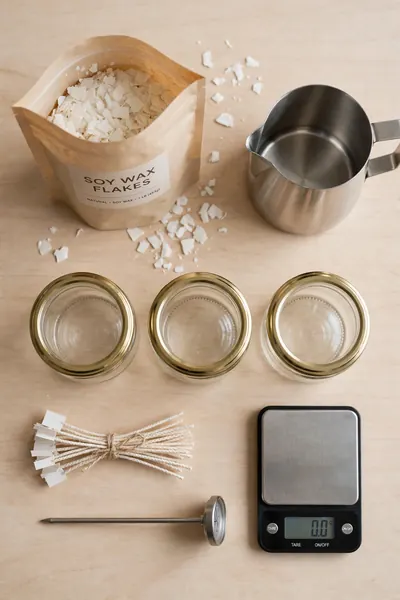
Quick Tip: Weigh your fragrance, never pour by eye. A small kitchen scale is the difference between a candle that fills the room and one you can barely smell, because scent loads are measured as a percentage of wax weight.
For one standard batch, start with 500 grams of soy wax flakes, three 8 ounce jars with lids, and cotton wicks with stickers to fit. Add a pouring jug, a thermometer, and your chosen scent source from the methods below. Everything on this list is reusable except the wax and wicks.
Fragrance Oils: The Strongest Swap and How Much to Use
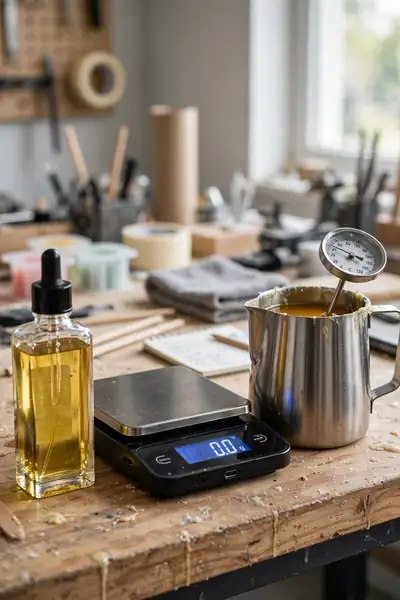
Common Mistake: Most beginners treat fragrance oil like essential oil and add a few drops, then wonder why the candle smells of nothing. A few drops in half a kilo of wax is a load of under 1 percent, far below what any candle needs.
The Fix: Weigh the oil at 6 to 10 percent of your wax weight: 30 to 50 grams of oil for 500 grams of wax. Add it when the wax cools to between 175 and 185 degrees Fahrenheit, then stir slowly for a full two minutes.
Buy oils made specifically for candles, not the general craft oils sold for soap or diffusers, because candle oils are tested to bind with wax and burn cleanly. Start at 8 percent for your first batch. That sits safely mid range, and you can adjust the next batch up or down from a known result.
The Spice Infusion Method for a Fully Natural Scent

What You Need:
- Two cinnamon sticks, six whole cloves, and two star anise for every 500 grams of wax, the standard spice ratio in this method.
- A small heatproof strainer or a piece of cheesecloth, to lift the spices out cleanly once the wax has taken their scent.
- A thermometer, because the infusion works at a low, steady heat and scorched spices turn bitter fast.
- Your usual 500 grams of soy wax and jars from the supply list, since the rest of the process stays the same.
- A timer, because 30 minutes of steeping is the target and guessing tends to run long.
Melt the wax, drop the whole spices in, and hold it just above melting point for 30 minutes, stirring now and then. Strain the spices out, let the wax cool slightly, and pour as usual. The scent that stays is warm and gentle rather than sharp, closer to a bakery doorway than a perfume counter.
Coffee and Vanilla Bean for a Warm Bakery Scent
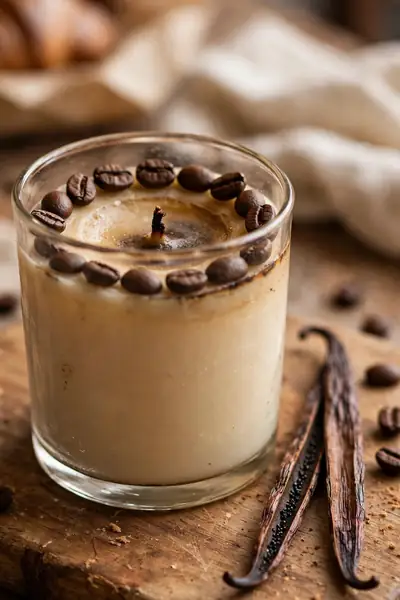
Before: A plain soy candle burns clean but smells of nothing much, and the jar looks like every other candle on the shelf. Coffee lovers and vanilla lovers walk straight past it.
After: The same jar carries a warm bakery scent, with whole coffee beans resting around its edges and a vanilla note underneath. It smells like a cafe corner and looks good enough to leave out on the counter.
Split one vanilla pod per 500 grams of wax, scrape the seeds into the melted wax, and steep the pod for 20 minutes before straining it out. After pouring, press 8 to 10 whole coffee beans into the soft top, kept near the edges, well away from the wick.
Dried Herbs and Citrus Peel, Used the Safe Way

Do This:
- Dry peels and herbs fully before they go anywhere near wax, at least a week in open air or a few hours in a low oven.
- Use about a tablespoon of dried lavender buds or rosemary per 500 grams of wax, steeped like the spices and strained out.
- Save a few pretty pieces for the top of the candle, pressed in around the edges once the surface starts to set.
- Pair citrus peel with a spice from the infusion method, because peel alone fades faster than most beginners expect.
Avoid This:
- Do not use fresh orange peel or fresh herbs; the water in them makes hot wax spit and can crack the surface.
- Do not scatter loose pieces across the whole top; anything near the wick can catch as the melt pool grows.
- Do not expect a strong room-filling scent from herbs alone; they give a gentle, close-up fragrance instead.
Worked this way, herbs and peels earn their place. The steeped batch scents the wax itself, the few pieces on top make the jar look handmade and giftable, and nothing sits where the flame can reach it. Light one after curing and the scent greets you up close, soft rather than loud.
Wax Melts: The No-Flame Way to Use Strong Natural Scents

Time Needed: about 1 hour plus setting time | Difficulty: Beginner | Cost: Low
Heat Source: an electric wax warmer, no open flame | Scent Strength: strongest of the natural methods
Best For: loose botanicals, coffee beans, and peels you would not put near a wick
Make melts in an ice cube tray or a silicone mold using scented wax from any method in this guide, poured in small portions instead of a jar. Without a wick, the warmer melts the piece evenly, so every bit of spice or peel gives up its scent instead of sitting untouched at the edges.
How to Add Scent to a Candle You Already Own
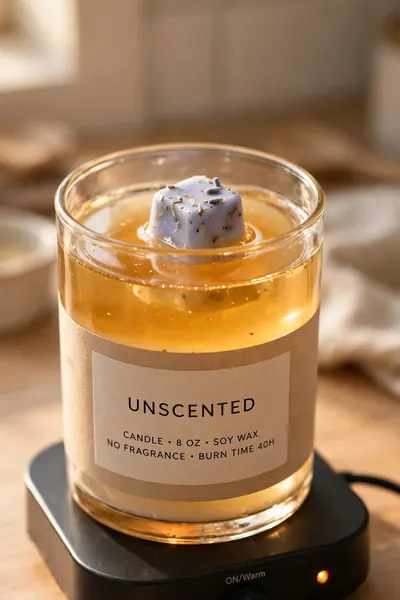
An unscented candle in your cupboard is not a lost cause, but it does need honesty first. Scent cannot be stirred into solid wax, and pouring oil over the top only perfumes the first burn before it pools and smokes. The wax has to melt again for scent to join it.
The safe workaround is a candle warmer. Set the jar on a warmer plate, let the top layer melt, then float a scented wax melt or a few scented wax chips from this guide on the pool. As both melt together, the borrowed scent spreads through the whole jar.
Five Scent Blends That Smell Beautiful Together
Also Explore: Make Candles Smell Stronger With These Easy Fixes Now
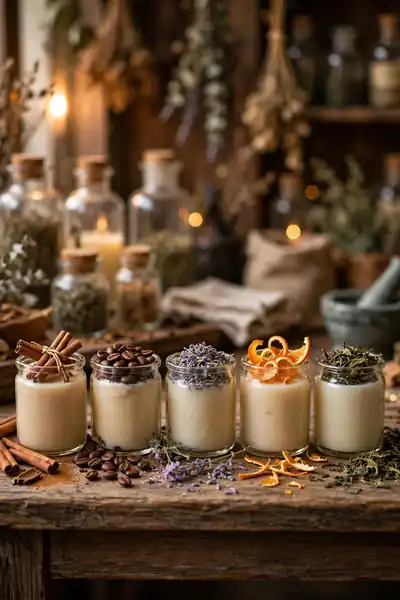
One scent on its own is pleasant, but two paired well are what make a homemade candle smell like the expensive kind. When you scent candles without essential oils, blends also cover each other’s weaknesses: sharp cinnamon gains warmth, and faint lavender gains company.
- Cinnamon Orange: the spice infusion from earlier, plus a strip of dried orange peel steeped with the sticks. Warm, bright, and made for winter evenings.
- Coffee Vanilla: one vanilla pod steeped in the wax and whole coffee beans pressed around the top edges. It reads like a quiet cafe.
- Lavender Rosemary: a tablespoon of lavender buds with half a tablespoon of dried rosemary, steeped and strained. Calm and herbal, best for bedrooms.
- Spiced Tea: two teaspoons of loose black tea leaves plus the cloves from the spice ratio, steeped together. Cozy and slightly sweet.
- Citrus Herb: dried lemon peel with dried rosemary, steeped briefly so the citrus stays on top. Fresh and clean for kitchens.
Curing and Storing So the Scent Actually Lasts

Quick Tip: For soy wax, patience is an ingredient. A soy candle can be burned after 48 hours, but its scent keeps deepening for up to two weeks as the fragrance finishes binding with the wax.
Once cured, store candles with their lids on, upright, in a cool dark cupboard away from sunlight and heat vents. Sunlight fades both color and scent, and a lid keeps dust off the surface and fragrance in the jar. Stored this way, a well-made candle keeps its scent for many months.
Mistakes That Leave a Candle Barely Scented

Common Mistake: The most common failure is a pile-up of small shortcuts rather than one big error: scent added to wax that was far too hot, stirred for ten seconds, and poured straight away. Each shortcut steals a little scent, and together they leave almost nothing by the first burn.
The Fix: Slow the three moments that matter. Let the wax cool to the right temperature before the scent goes in, stir gently for the full two minutes, and give the finished candle its full curing time before judging it.
Two other thieves are worth checking. Fresh or damp botanicals weaken scent and rough up the surface, so dry everything, and a wick that is too small never melts the wax wide enough to release what is in it. Fix those, and most weak candles turn out to have been one habit away from good.
Frequently Asked Questions
1. Which method gives the strongest scent of all?
Candle fragrance oils give the strongest, most reliable result, because they are made to bind with wax and throw scent when burned. Among the fully natural options, wax melts come out strongest, since there is no flame consuming the fragrance as it releases.
2. How much fragrance oil do I add to 500 grams of wax?
Between 30 and 50 grams, which is a load of 6 to 10 percent of the wax weight. Start at 40 grams, the 8 percent middle, for your first batch, then adjust the next batch up or down based on how that one performs.
3. Why does my candle smell strong unlit but weak when burning?
Three causes cover most cases: the scent went into wax that was too hot, the candle was burned before it finished curing, or the wick is too small to melt the wax wide. Give soy candles up to two weeks of curing, and test a larger wick before changing anything else.
4. Are dried flowers and herbs safe on top of a candle?
Yes, with the rules from this guide: fully dried pieces only, pressed around the edges at least an inch from the wick, and the candle never left burning unattended. If you want heavier decoration than that, put the botanicals in wax melts instead, where there is no flame at all.
5. Can I combine fragrance oil with the spice infusion?
Yes, and the blends section is built on exactly that idea. When you layer oil over an infused batch, keep the oil near the lower end of the range, around 6 to 7 percent, so the combined scent stays warm instead of turning harsh.
6. Can I use perfume or room spray to scent a candle?
No. Perfumes and sprays are not made for wax or for open flame. They burn off in the first minutes, smell harsh rather than pleasant, and can make the flame flare. Stick to candle fragrance oils or the pantry methods in this guide.
Conclusion
A candle that scents a room does not need essential oils at all. It needs the right scent source, weighed properly, added at the right temperature, and given time to cure. I’ve seen how making this one change can completely shift the result. You now have five ways to scent candles without essential oils, from strong fragrance oils to a quiet spice infusion, plus the blends and storage habits that keep them at their best. Start with one batch this weekend, and save this guide to your candle board on Pinterest so it is there for the next one. Share it with a friend whose candles never smell strong enough.




One Comment