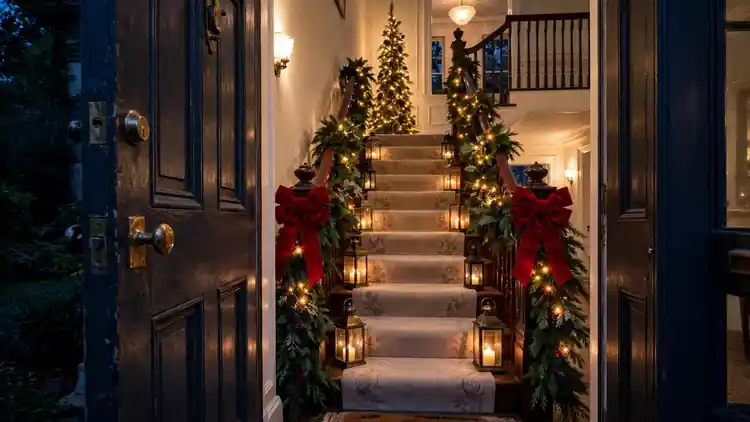
22 Christmas Staircase Decor Ideas for Grand Entries
Your front door opens, and before the tree, before the table, your guests meet the staircase. I’ve noticed it decides the whole welcome in ten seconds flat. Done well, christmas staircase decor turns that tall bare climb into the moment guests remember in June.
Inside are 22 ideas for every surface the staircase owns: swagged garlands, glowing lanterns, landing scenes, the nook beneath, and the gallery wall climbing beside it. Every idea carries its measurements, its safe way to hang, and its place for small stairs and rentals too.
Measure once this weekend. By Sunday night, your stairs can be the backdrop of every photo this Christmas.
Why the Staircase Is the First Thing Guests See
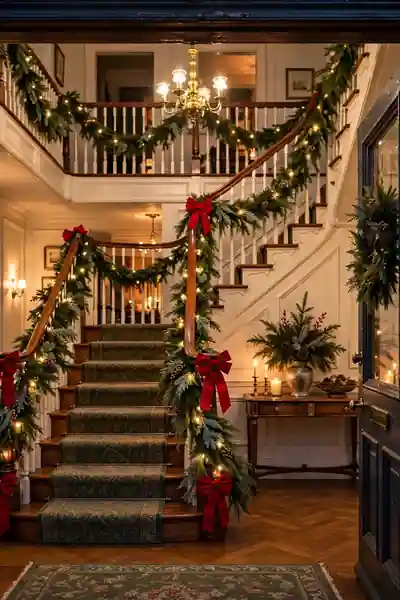
Guests read your home in the first ten seconds, and the staircase fills most of that view. It is the tallest, most photographed surface in the entry, rising through two floors of sightlines. Decorated well, it makes the whole house feel festive before a single room is seen.
Bare stairs do the opposite. They make even a decorated tree in the next room feel like an afterthought, because the eye lands on the staircase first and keeps returning to it. That is why the stairs deserve the first decorating hour, not the leftover one on Christmas Eve.
Measure the Banister and Set the Safety Rules
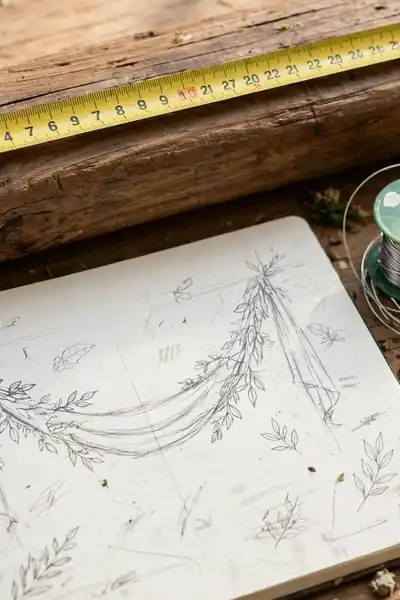
Most christmas staircase decor fails on arithmetic, not taste: too little garland, swags that sag unevenly, and lights that end mid rail. Ten minutes of measuring first turns the whole job into simple, repeatable numbers. Measure once, and every swag matches its neighbor.
- Measure the banister’s full length along the slope, then add half again for swags; a flat 12 foot rail needs about 18 feet of garland.
- Mark swag points every 4 to 5 feet with painter’s tape, so drops land evenly.
- Keep the handrail’s top grip clear: decorations hang on the outer face and below, never where hands slide.
- Plan power now: battery packs for mid rail lights, and cords only where they can hide along the wall edge.
Also View: 21 Christmas Entryway Decor Ideas Ready to Wow Guests
Evergreen Garland in Deep Swags

Quick Tip: Build each swag on the floor first. Shape one perfect loop of garland, measure it, then copy that loop along the rail. Identical swags, not hopeful ones, are what make a banister look professionally dressed.
Attach with floral wire or soft ties at the marked points, never nails, and fluff each swag outward so the greenery faces the room. Real garland smells wonderful and dries by week three; quality faux garland keeps its shape for a decade of Decembers. Either wins when the swags match.
Fairy Lights Woven Through the Garland

Before: The garland looks handsome at noon and disappears by five. Winter dark swallows the banister whole, and guests climb a staircase they can barely see, holding a rail dressed for a season the light forgot.
After: A loose weave of warm fairy lights turns the same garland into the home’s evening lantern. Every swag glows softly, the steps read clearly, and the staircase becomes the photo everyone takes without being asked.
Weave the strand in wide S curves, never wrapped tight, so bulbs sit between branches instead of strangling them. Battery packs hide at the posts where hands can reach the switch. Match the bulb color to your living room lamps; one warm tone everywhere always reads richer than three.
Big Bows on Every Newel Post

What You Need:
- Wide wired ribbon: two and a half to four inches, in velvet or plaid, about three yards per bow.
- One bow per newel post: the bottom, the landing turn, and the top, matched in size.
- A sprig of greenery or berries: tucked behind each bow for depth.
- Floral wire or zip ties: for a hold that survives sleeves, bags, and excited children.
Bows are the fastest grand gesture in this whole list: twenty minutes, no ladder, no damage. Make them on the table where loops can be measured equal, then wire them on. I’ve noticed posts dressed alike make even a plain garland look planned by a professional.
Stockings Along the Banister
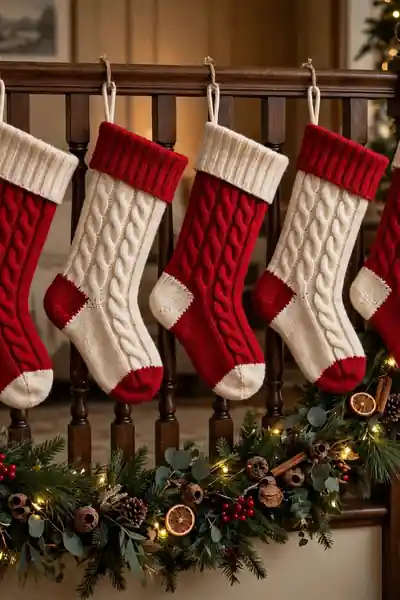
Before: Stockings crowd the mantel where heat dries them and elbows knock them, or they wait in a box because this home has no fireplace at all.
After: The banister becomes the mantel. Stockings hang in a gentle row along the rail, each name readable, each one reachable on Christmas morning without moving furniture or lighting anything.
Hang them on the outer face of the rail with ribbon loops, spaced a hand’s width apart, hung by the loop so they sit straight when filled. Keep heavy fillers for the morning itself; an empty stocking holds its shape, a stuffed one stretches its cuff by New Year.
Lanterns on Every Third Step
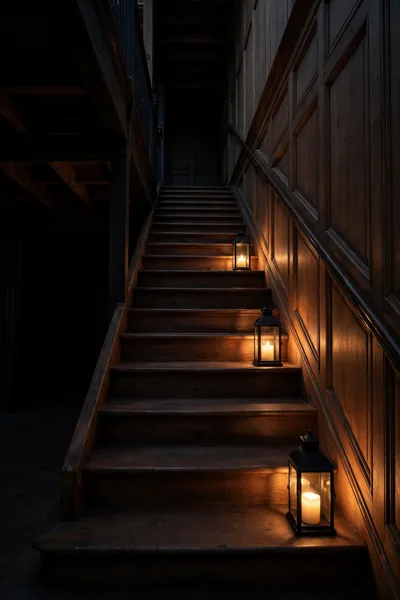
Do This:
- Keep every lantern on the same side, against the wall or the balusters.
- Leave the middle of each step fully clear for feet, day and night.
- Choose battery candles with timers, so the staircase lights itself at dusk.
- Match lantern sizes to step depth; small stairs take small lanterns.
Avoid This:
- Real flames on steps, where hems, pets, and children pass within inches.
- Lanterns on both sides, which narrows the walking lane to a squeeze.
- Glass lanterns on the bottom step, the one every vacuum and suitcase meets.
Steps stay stairs first and decoration second; that order keeps the beauty welcome. One lit side reads as a designed runway of light, while both sides lit reads as an obstacle course. Guests will photograph the runway, and nobody trips for a photo.
Mini Wreaths on the Balusters

Cost: Low | Time: One hour | Spacing: Every third or fourth baluster | Best For: White or light painted stairs
Tie each wreath on the room side of the baluster with a ribbon bow at its top, at exactly the same height as its neighbors. Rhythm is the whole trick here: identical size, identical drop, identical bow. One crooked wreath is a mistake; a row of straight ones is a design.
Poinsettias on Alternating Steps
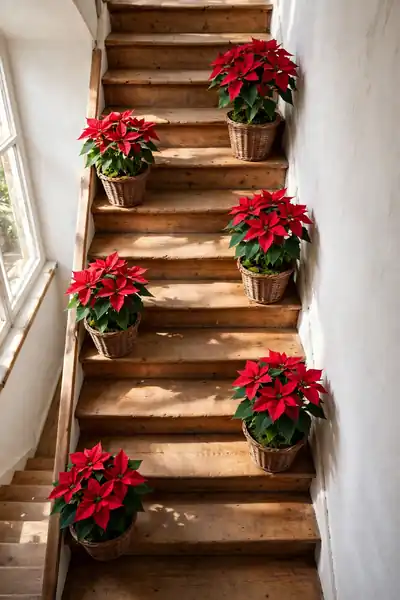
Poinsettias bring the strongest red in the season without a single ornament. Set one plant on every second or third step, tight against the wall side, so the walking lane stays wide and clear. In their baskets they read as a staircase garden, deliberate and fresh.
Faux plants earn their place in busy homes: no watering on the stairs, no dropped leaves, and no worry about the plant’s known risk to curious pets. Real plants belong on the landing instead, watered at a sink. Either way, the rhythm of red stepping upward does the decorating.
A Slim Tree on the Landing
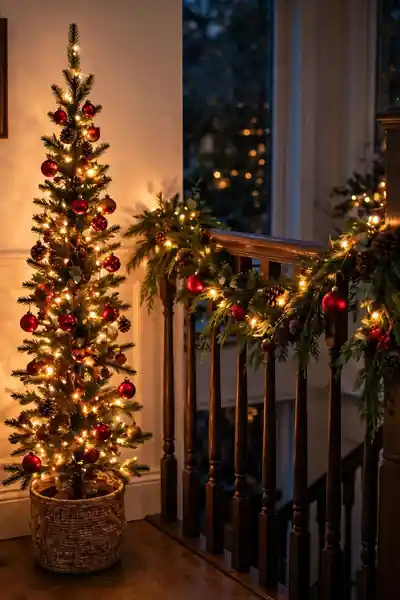
A landing is a stage the whole house can see, and a slim tree fits it like it was designed there. Pencil trees take under a foot of floor, dress fully with lights and ornaments, and turn the turn of the stairs into the home’s holiday postcard.
- Measure the landing’s depth and choose a tree at least six inches narrower.
- Place it in the corner away from the handrail’s end, so hands pass freely.
- Dress it in the same colors as the banister garland, so the two read as one scene.
- Run its cord flat along the wall to the nearest outlet, taped or covered, never across the turn.
Baskets of Greenery at the Landing Turn
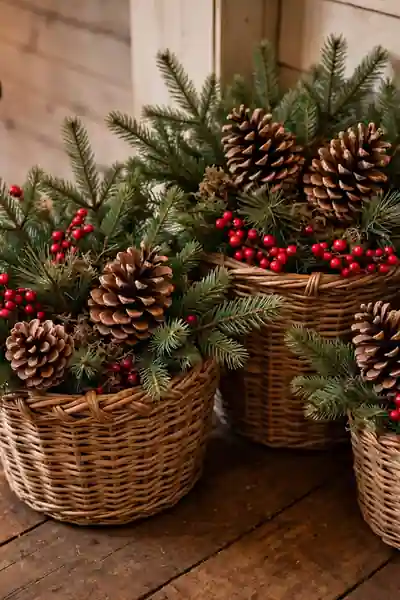
Quick Tip: Fill baskets two thirds with scrunched paper or old towels first. Greenery arranged on a raised base looks abundant with half the branches, and the basket stays light enough to move for vacuuming.
Where stairs turn, a corner usually collects shoes and bags. Baskets claim that corner beautifully instead: three sizes grouped, tallest at the back, filled with the same greenery as the rail. In my experience, guests slow down at landings, so whatever waits there gets the longest look in the house.
Glowing Village Houses on the Landing

Before: The landing wall is a pass through: blank, echoing, forgotten between floors. Nothing gives the eye a reason to pause between the bedrooms and the door.
After: A small glowing village turns the pass through into a destination. Children stop on the turn every single trip, and adults pretend they are only checking the lights.
Set the houses on a narrow shelf, a stack of books, or the landing’s window ledge, with one battery tea light per house. Keep the row shallow so the walking line stays wide. A village built a house or two per year grows into the family’s most loved staircase tradition.
Hanging Ornaments on Ribbons

What You Need:
- Shatterproof baubles: in two sizes and one color family, about one per foot of rail.
- Ribbon in two lengths: cut pieces at 8 and 14 inches for a gentle rhythm.
- The outer face of the banister: ornaments hang over the stair side, never over the walking lane below the rail’s grip.
- A step stool: for tying the high end of the rail without leaning over the drop.
Varied lengths keep the row alive; identical lengths look like a shop display. Tie each ribbon with a small bow at the rail so the hanging itself decorates. From below, the baubles float like the tree escaped and colonized the staircase, which is exactly the delight intended.
Paper Snowflakes in the Stairwell

Before: The stairwell’s tall air is the emptiest space in the house: two floors of nothing above the busiest path in the home.
After: Snowflakes drift at staggered heights, turning with the air each time the door opens. The whole staircase feels like the inside of a snow globe, for the price of paper and thread.
Hang flakes on clear thread from the ceiling or upper rail, longer threads toward the tall end so the snowfall follows the slope. Keep every flake at least a head’s height above the steps below it. Cut them in two sizes only; a blizzard of sizes reads as clutter, not weather.
Eucalyptus and Pinecone Garland
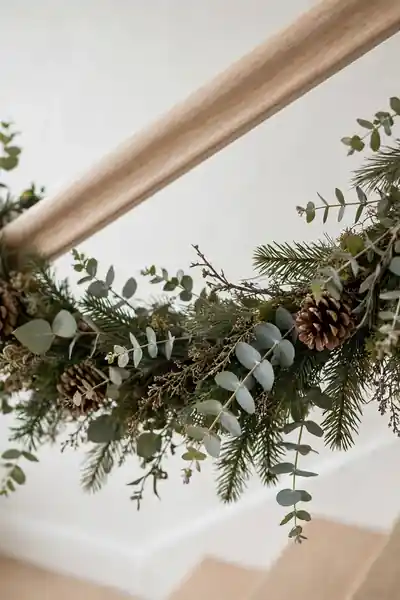
Do This:
- Mix two greens: pine for body, eucalyptus for softness and scent.
- Wire pinecones in clusters of three at each swag’s lowest point.
- Let some eucalyptus trail longer than the pine for a relaxed edge.
- Pair with cream or wood tones elsewhere on the stairs.
Avoid This:
- Spray glitter on natural elements; it fights the whole calm idea.
- Real eucalyptus where pets chew; use faux stems in pet homes.
- Forcing this soft look onto a very formal dark staircase.
Not every home wants red. This garland suits the quiet houses: pale wood, linen, winter light. Guests describe these stairs as peaceful, which in December is its own luxury. The same swag spacing from the classic garland applies; only the palette changes.
Dried Orange and Cinnamon Garland

Cost: Very low | Time: One drying afternoon plus stringing | Scent Life: About three weeks | Best For: Rustic and farmhouse stairs
Dry orange slices low and slow in the oven until they glow like stained glass, then string them with cinnamon sticks and wooden beads. The banister smells like Christmas baking every time someone passes. Refresh tired slices mid season; the scent fades before the color does.
A Velvet Ribbon Cascade

Some staircases need one gesture, not twelve. A cascade of velvet ribbon from the top post pours down the banister like the staircase is wearing a scarf for the season. The bottom pool of ribbon, arranged in soft folds on the last step’s edge, finishes the sentence.
Choose ribbon with wire edges so the flow holds its shape against sleeves and drafts. One color only, deep red or forest green, and nothing else on the rail. In my experience this is the most photographed idea in the list, because it looks like a hotel staircase and costs less than lunch.
Bells and Buffalo Plaid Bows

Plaid and brass are farmhouse Christmas in two materials. Small bows at every post and landing, each with two bells, dress the staircase in a pattern that reads from the street door. The bells do the second half of the decorating, in sound.
- Tie bows smaller than the newel post bows, about four inches across.
- Thread two bells onto the bow’s center knot before tightening it.
- Space bows evenly: every post, plus one at each swag’s center.
- Test the jingle by walking the stairs; bells should whisper, not announce.
Nutcrackers Standing Guard on the Steps
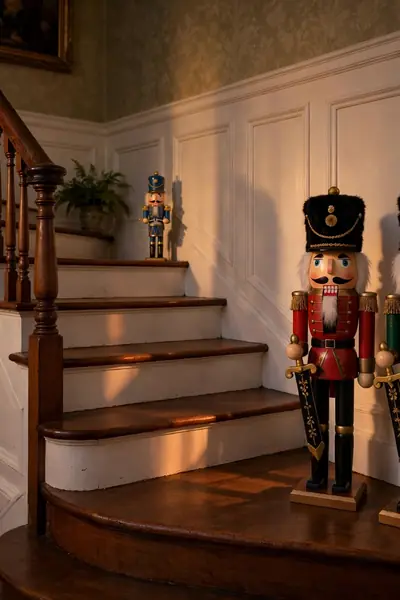
Quick Tip: Size nutcrackers to the staircase, not the shop shelf. A figure taller than the step’s riser looks lost; one around knee height on a wide step reads as a guard, not a toy left behind.
Place them tight against the wall side, on the widest steps only, in odd numbers if you use three. Children name them within a day. That naming is the real decoration: guards with names get greeted every morning, and a staircase people greet is a staircase doing its job.
A Festive Gallery Wall Up the Stairs

Before: The stair wall holds the family’s oldest frames in a straight line that fights the slope, or nothing at all: two floors of bare plaster above the busiest path in the house.
After: Prints climb with the stairs, each frame’s center following the handrail’s angle. The walk up becomes a slow gallery of winters, and guests climb at half speed without noticing why.
Swap seasonal prints into frames you already own; the frames stay, only the art changes with the season. Keep the line of centers about five feet above each step’s nose. Red mats or one gold frame in three gives the climb its holiday note.
Garland on Both Handrails
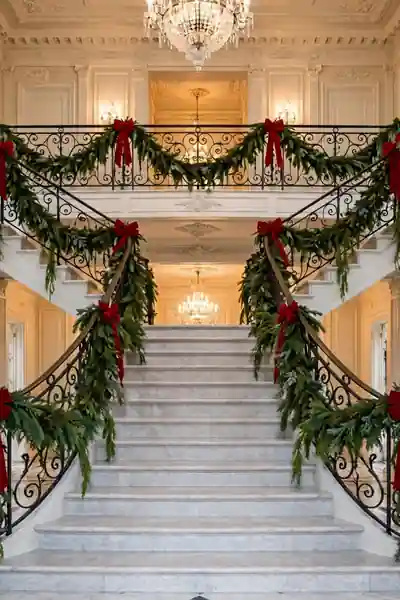
What You Need:
- Double the garland of a single rail: measure both sides before buying, plus half again for swags.
- Matching bows and lights: bought in one batch so both sides truly match.
- A center point: the landing or middle post dressed slightly fuller, as the scene’s anchor.
- Two people for hanging day: one per side, keeping swags level with each other.
Symmetry is the whole luxury here. Dress the side guests see first, then copy it exactly, swag for swag, on the other. Photograph from the front door and adjust until the two sides mirror. Wide staircases forgive fullness; skimping is the only way this idea fails.
The Space Under the Stairs
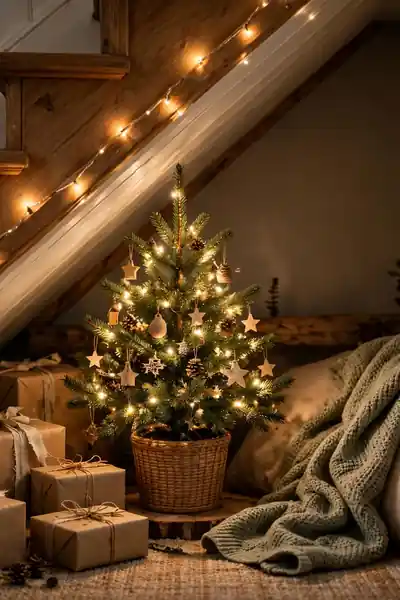
Before: Under the stairs is the house’s shrug: suitcases, a vacuum, and boxes nobody opens. The most central cupboard in the home stores its least loved things.
After: Cleared and dressed, the nook becomes a tiny Christmas room: a small tree, a cushion, gifts waiting out of sight. Children claim it within the hour as a fort with better lighting.
This only works if the stored things get a real new home first, not a hallway pile. Keep the nook’s floor clear enough to crawl into, and run lights on batteries so no cord crosses the doorway. A decorated nook photographs like a magazine secret.
Presents and a Sleigh at the Staircase Foot

Do This:
- Anchor the group tight to the staircase’s side, never narrowing the first step.
- Wrap empty boxes for height; real gifts join on Christmas Eve.
- Repeat the banister’s ribbon on the boxes so base and rail match.
- Add one battery lantern inside the sleigh for a glow at ankle height.
Avoid This:
- Blocking the bottom step’s landing space where feet turn.
- Real gifts out early in homes with curious toddlers or dogs.
- A pile so wide it swallows the entry’s walking path.
The foot of the stairs is where the whole decoration gets framed. A sleigh group gives the eye a place to land before it climbs, the way a period ends a sentence. Keep it tight, matched, and glowing, and the staircase reads finished from the doorway.
One Grand Center Swag With an Oversized Bow

Cost: Medium | Time: Under one hour | Impact Point: The banister’s exact center | Best For: Minimal homes and formal stairs
Restraint reads expensive. One deep, generous swag at the center, fluffed wide, with a single bow the size of a wreath, dresses a formal staircase better than greenery everywhere. Build this swag fuller than the others in this list: two garlands twisted together, because it performs alone.
Also Explore: 24 Christmas Decor Ideas for Living Room Sweet Warmth
Safety First: Clear Handrails, Kids, and Pets

A handrail has one job, and decoration must never apply for it. Hands slide along the top of the rail in the dark, in socks, carrying laundry and children. Everything in this article hangs on the outer face, the balusters, or the steps’ edges, precisely so a falling hand always finds clean wood.
Battery lights replace cords and flames on stairs, always. Poinsettias and other risky plants sit where pets cannot reach, or go faux. Check every tie after the first week; greenery shifts as it dries. In my experience, ten minutes of safety checks in week one is what lets the pretty parts stay pretty all season.
Mistakes That Make Stair Decor Look Messy
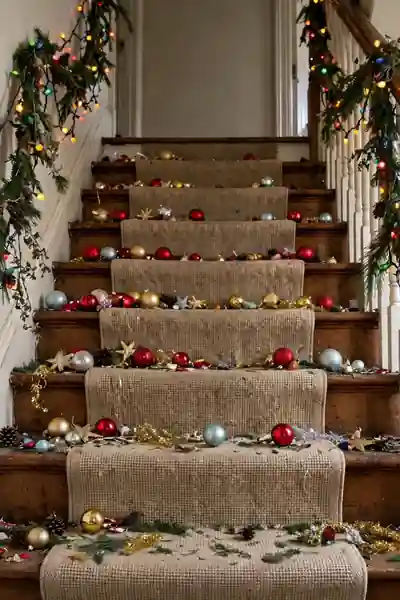
Common Mistake: Decorating by enthusiasm instead of numbers. Swags eyeballed instead of measured, three light colors from three old boxes, and ornaments placed wherever a hand happened to reach.
The Fix: Return to the measuring section. Even swags at marked points, one light color everywhere, and every item given a spacing rule before it goes up. Order is what the eye calls beauty on a staircase.
Most mess is really drift: ties loosen, bows slide, and one fallen ornament stays on a step for a week. A two minute straighten during the weekly reset keeps December tidy. Photograph your stairs from the front door; the camera shows disorder the loving eye edits out.
Frequently Asked Questions
1. How much garland do I need for my banister?
Measure the rail along its slope and add half again for swags. A 12 foot banister usually needs about 18 feet of garland, and a two swag staircase with deep drops can need double its flat length.
2. How do I attach garland without damaging the wood?
Use floral wire, soft fabric ties, or banister clips made for the job, and pad any wire with a scrap of ribbon where it touches polished wood. Never nails, screws, or hot glue on a banister.
3. Is real or faux garland better on stairs?
Faux wins for most homes: it keeps its shape, drops no needles on the steps, and returns every year. Real garland smells wonderful but dries within weeks and belongs on shorter runs like a mantel.
4. My staircase is narrow. Can I still decorate it?
Yes, decorate the vertical surfaces only: the banister’s outer face, the balusters, and the wall. Keep steps, the handrail grip, and the walking lane completely empty, and the stairs will feel festive, not crowded.
5. What is safe around toddlers and pets?
Battery lights instead of cords, shatterproof ornaments, decorations tied firmly above reach, and risky plants like poinsettias kept on high landings or swapped for faux versions. Check ties weekly.
6. How do I store staircase decorations in January?
Photograph each section before taking it down, coil garlands loosely in large bags, and label one box “stairs” with the photo inside. Next December starts with your own instructions waiting.
Conclusion
The staircase was never just a way upstairs. Dressed with swags, light, and a scene on the landing, it becomes the welcome itself, the backdrop behind every arrival and every photo. That is the quiet power of christmas staircase decor: one tall surface, dressed once, greeting everyone all season.
I’ve seen how small changes like these can completely shift the way a space feels. Save this guide on Pinterest before your garland shopping, start with the swags this weekend, and share it with the friend whose entry deserves its moment. Her staircase is about to become the most loved wall in her house.