24 Relaxed Boho Living Room Ideas Bursting With Soul
The rooms people never want to leave are never the perfect ones. They are the soft ones, with a worn rug, a chair that has a past, and light that flatters everyone in it. These relaxed boho living room ideas build exactly that kind of room, one honest layer at a time.
Nothing here needs a renovation or a big budget. You will find the palette that calms the room first, the textiles and rugs that soften it, plants at three heights, thrifted pieces with soul, and the styling rules that keep layers looking collected instead of cluttered, even in a small rented room.
Start With Soul: What Relaxed Boho Really Means

Relaxed boho is not a shopping list. It is the feeling of a room that grew slowly: a chair from a flea market, a rug softened by years of feet, a plant that found its own corner. Nothing matches on purpose, yet everything belongs together in the end.
The 24 ideas ahead work in any order, because boho has no single starting line. Begin with what your room lacks most: softness, color, light, or life. Add one layer, live with it a week, then add the next. Slow rooms end up with the most soul.
An Earthy Color Palette That Calms the Room
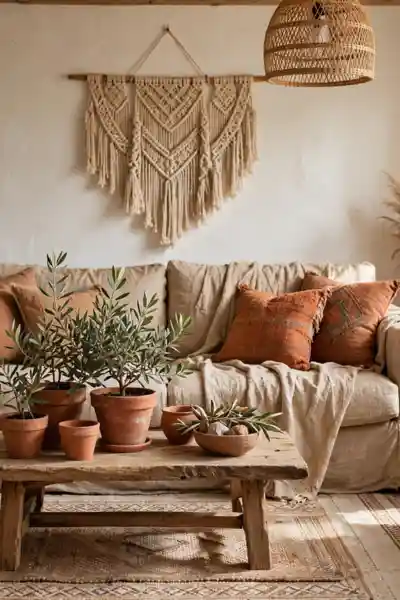
Every calm boho room you have ever saved starts with the same quiet base. Warm white walls, then clay, sand, olive, and rust in the textiles and pots. Get the palette right first and every later layer feels easy, because nothing new can clash with earth.
- Set the big surfaces first: warm white or pale sand on walls, natural wood or jute on the floor.
- Pick three earth colors, such as clay, olive, and rust, and repeat each one at least twice in the room.
- Count wood tones as colors too, and keep them in one warm family.
- Add one dark accent, charcoal or black, in just two or three small places for depth.
Hold a cushion against the wall before buying anything else in its color. In my experience two minutes of checking saves a season of almost right purchases, and a tight palette is the cheapest calm a living room can buy at any budget level comfortably.
Also View: 21 Effortless Ways to Style Your Couch With Pillows
Layered Textiles for Softness
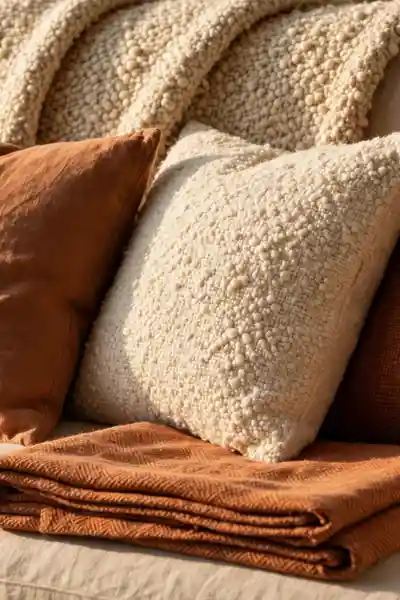
Quick Tip: Layer in threes and stop. One throw over the sofa back, one folded at the seat edge, and cushions in odd numbers give the full soft look; a fourth layer is where cozy quietly turns into clutter that nobody wants to sit in.
Mix the weaves, not just the colors: a nubby throw beside smooth linen, a woven cushion against a plain one. Texture contrast is what makes a simple sofa read as boho, and it costs nothing extra, because the pieces you already own usually mix well enough.
A Jute Rug Under Everything

Common Mistake: Buying a rug that only fits under the coffee table. A small rug floats like a bath mat in the middle of the room, the seating around it looks temporary, and the eye reads islands instead of one gathered place.
The Fix: Size the rug to the seating, not the table: it should slide at least six inches under the front legs of every sofa and chair it serves.
Measure before you shop: the rug should reach at least six inches under every seat around it. Jute hides crumbs, sand, and pet hair between vacuums, sheds a little in its first weeks, and then settles into the hardest working surface in the whole room.
A Second Rug Layered Over the First

What You Need:
- One large plain base rug in jute or a flat weave
- One smaller patterned rug, about two thirds the size
- Thin rug pad strips to stop the top layer wandering
- Colors that already live in your palette
Angle the top rug slightly or set it straight, both work when the colors talk to each other. A faded vintage style rug over plain jute is the classic pairing, and the layered edge is exactly where the eye reads collected instead of decorated on purpose.
Rattan and Wicker Furniture

Before: Every surface in the room is upholstered, painted, or flat packed. The seating is comfortable enough, but the room feels heavy and slightly airless, as if nothing in it was ever touched by a hand.
After: One woven chair arrives and the room breathes. Light passes through the weave, shadows pattern the wall behind it, and every solid piece nearby looks softer by comparison.
One piece is enough to start: a chair, a side table, or even a woven lampshade carries the signal. Check secondhand pieces for broken strands at the joints, and keep rattan out of harsh direct sun, which dries the cane and makes it brittle over time.
A Low, Deep Sofa You Can Sink Into
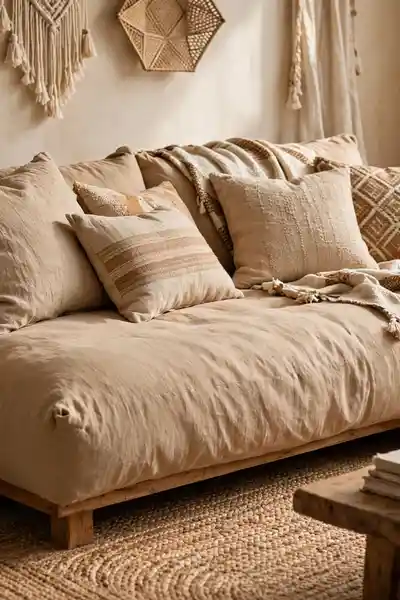
Do This:
- Choose a low back and a deep seat you can sit sideways in
- Pick a washable cover in linen, cotton, or another natural weave
- Keep the legs short and wooden, or hide them under the skirt of the seat
- Dress it down with cushions in odd numbers
Avoid This:
- Stiff upright sofas made for sitting formally
- Shiny synthetic fabrics that slide and gleam
- High arms that box the seat in like a waiting room
- Pale covers that cannot be washed in a home with life in it
Test a sofa by sitting the way you actually live: sideways, legs up, a book in hand. If the seat swallows you kindly, it is the right anchor, and every softer layer you add later will only make the invitation stronger for guests and family.
Floor Cushions and Poufs

Cost: Low to mid | Best For: Extra guests and floor living | Storage: Stacked in a corner | Result: Seating that appears when needed
Floor cushions turn movie nights and board games into floor events, which is exactly the relaxed register boho aims for. Choose firm fills that hold a sitter, covers that unzip for washing, and colors pulled straight from your palette so they never look spare or random.
Low Level Seating Around a Low Table
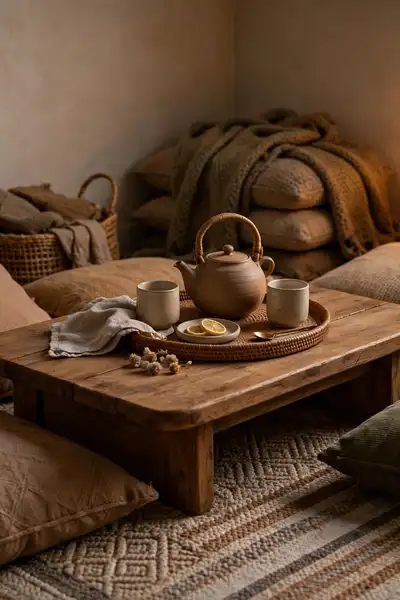
Some corners ask for a slower speed. A low table with cushions around it changes how an evening runs: tea lasts longer, games spread out, and nobody perches on a chair edge waiting to leave. It is the oldest seating arrangement on earth, and it still works.
Keep the table sturdy and the cushions thick, because floor sitting punishes skimping within twenty minutes. A tray on the table holds the pot and cups steady, and a rug underneath defines the little country this corner declares inside the bigger room around it.
Houseplants at Three Heights
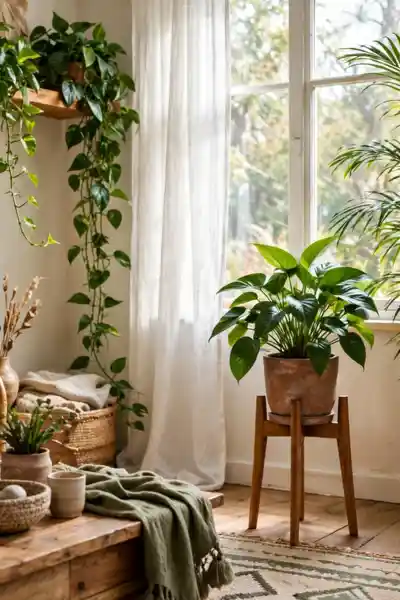
A single plant on a shelf reads as an apology. Plants at three heights read as a climate: something tall in the corner, something mid level on a stand, something trailing down from above. The eye travels, and the room feels grown rather than decorated.
- Set one tall plant in the corner, a rubber plant, palm, or fiddle leaf in a floor basket.
- Add one mid level plant on a stand or stool beside the sofa.
- Trail one plant down from a shelf, a hanger, or the top of a cabinet.
- Repeat one pot material, clay or basket, at all three levels to tie them together.
Start with the tall one, because height is the layer most rooms lack entirely. Clay and basket covers keep the pots inside the palette, and a plant that outgrows its level simply moves up a rank, which makes the whole system pleasantly hard to ruin.
Macrame Wall Hangings

Quick Tip: Hang the largest hanging you can afford over the sofa, centered on the seat, not the wall. A small hanging floats lost on a big wall, while one generous piece does the work of a headboard and a painting at the same time.
Cotton cord softens the hardest wall in the room and absorbs a little echo while it is there. I’ve noticed rooms feel quieter, not just softer, once a large textile hangs in them, which is part of why boho living rooms invite long conversations at home.
Woven Wall Baskets as Art

Common Mistake: Lining the baskets up in a perfect row or a tidy grid. Measured spacing kills the collected feeling instantly, and the wall ends up looking like a shop display of baskets for sale instead of art that grew there.
The Fix: Cluster them loosely in odd numbers, edges nearly touching, sizes mixed, and let one basket sit slightly higher than feels planned.
Start with one large basket and add around it as finds appear, so the wall honestly grows over time. Flat baskets cost little, weigh almost nothing, and hang on a single small nail, which makes them the friendliest large art a renter can own today.
A Gallery Wall That Grew Over Time
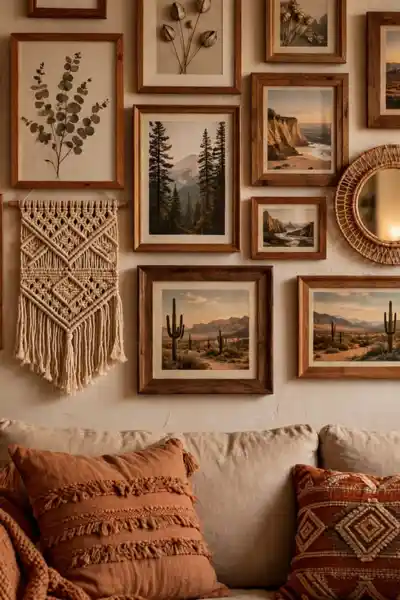
What You Need:
- Frames in mixed warm wood tones, thrifted over time
- A mix of prints, photos, postcards, and one small painting
- One small mirror to catch light
- One woven or textile piece for softness
- Paper templates and tape for planning the layout on the wall
Hang the biggest piece first, slightly off center, and let everything else answer it. A gallery that mixes art with one mirror and one woven piece feels collected over years, while a matching frame set always confesses it arrived in one box last Tuesday morning.
String Lights and Lanterns for Evening Glow
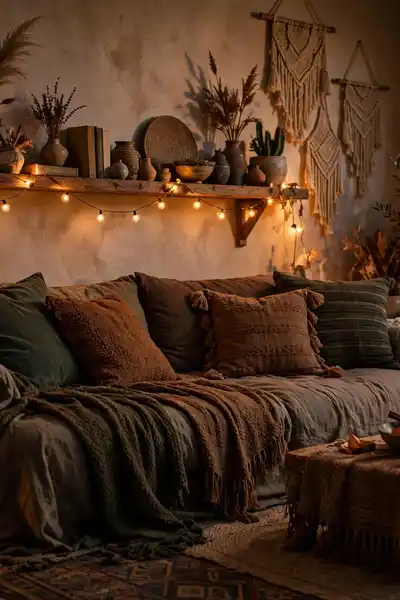
Before: At seven in the evening the ceiling light goes on, and the room turns flat and glaring. Every soft texture you layered in daylight vanishes under one hard white bulb, and nobody lingers.
After: Small warm lights take over at knee and table height: a string along the shelf, lanterns glowing beside the sofa. Faces soften, fabrics deepen, and the room becomes the place the evening gathers.
Keep every bulb warm toned and low: light at knee and table height flatters faces and fabrics alike. Battery lanterns go where sockets are not, and a timer switch means the room greets you already glowing when you walk in after dark each evening at home.
Vintage and Thrifted Pieces With a Past
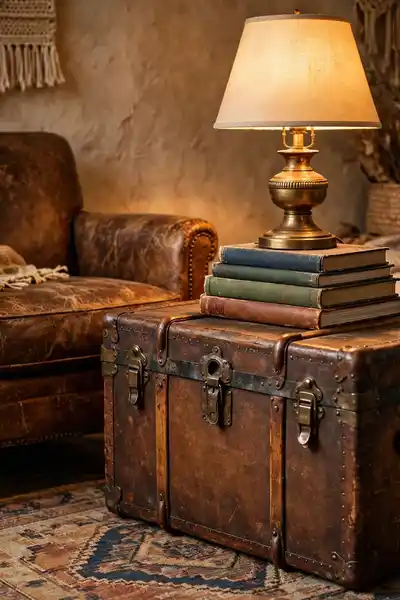
Do This:
- Give every zone of the room one genuinely old hero piece
- Clean and repair finds, then let honest wear stay visible
- Mix eras freely: a fifties lamp can love a handmade trunk
- Ask sellers the story and let the piece keep it
Avoid This:
- Brand new pieces faked to look distressed
- Restoring an old piece until its whole past is sanded off
- Matching every piece to one strict period
- Hiding the scars that make the piece interesting
A room where everything is new feels like a showroom, however soft the fabrics are. One trunk with travel scars or a lamp with a brass patina gives every newer piece beside it a borrowed history, and the whole room relaxes into being believable at last.
Open Wooden Shelving, Styled Loosely

Cost: Low | Best For: One blank wall | Rule: Fill two thirds, leave one third air | Result: Storage that decorates
Style shelves the way a bookshelf in a loved home actually looks: books lying down in short stacks, a bowl here, a plant trailing there. Leave real gaps, because empty space on a shelf is what tells the eye the filled parts were chosen with care.
Terracotta and Clay Accents

Unglazed clay is boho’s quiet workhorse. A terracotta pot, a handmade vase, a rough bowl on the table: each one brings the palette down to earth and gives shinier objects something honest to sit beside. The color is already inside your palette, so nothing can clash.
Scatter three clay pieces where the eye travels: one by the sofa, one on the table, one on a shelf. This is where boho living room ideas stop being a theme and start being a texture, repeated softly until the whole room hums at the same warm pitch.
An Arched Mirror or Window Frame
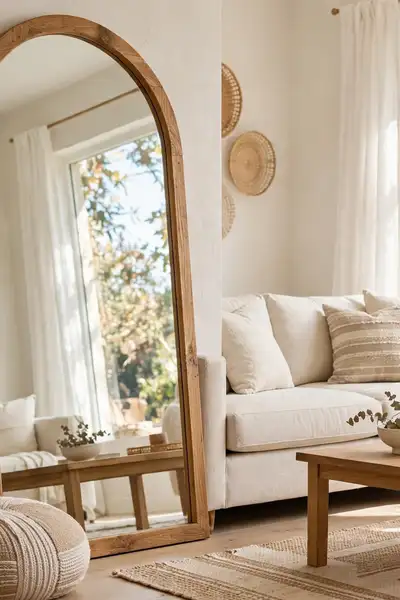
Living rooms are mostly straight lines: sofas, shelves, screens, doors. One arch breaks the grid the way a curve breaks a long road, and a mirror inside the arch doubles the light while it does it, which is two gifts from a single piece.
- Place the arch where it can catch a window, opposite or beside one.
- Lean a large mirror safely, and hang a small one on two fixings.
- Set it over the sofa or a console, where the room’s eye already lands.
- Keep the frame in warm wood or black, so it stays inside the palette.
An old arched window frame works even without glass, as a piece of architecture the room borrowed. Either way the arch becomes the thing guests ask about, and it asks nothing back except a wall and the light it was positioned to catch each day.
A Hanging Chair Corner

Quick Tip: Anchor into a ceiling joist, never into plaster alone, and test the chair with your full weight sitting low before anyone swings. A hanging chair that holds a quiet reader for a year starts with ten honest minutes of hardware checking.
Put the chair where the light is, by the window, with a cushion, a throw, and a small table within reach. It becomes the seat every guest tries first and the seat the owner defends, which is a lot of joy from one corner and one strong hook.
Draped Fabric in a Quiet Corner

Common Mistake: Stretching the fabric tight and flat across the corner like a spare sheet. Pulled flat, cloth shows every crease and reads as a laundry accident, and the corner loses the softness the drape was bought for.
The Fix: Let the fabric fall in loose folds from a rail or two high hooks, with more cloth than the span needs, so it moves slightly whenever the air in the room moves.
Gauze, muslin, and thin linen all drape kindly and cost little by the yard. A draped corner gives kids a fort, adults a reading shade, and the room one soft mystery, which is a remarkable amount of work for a single length of cloth at home.
A Boho Coffee Table With Layers
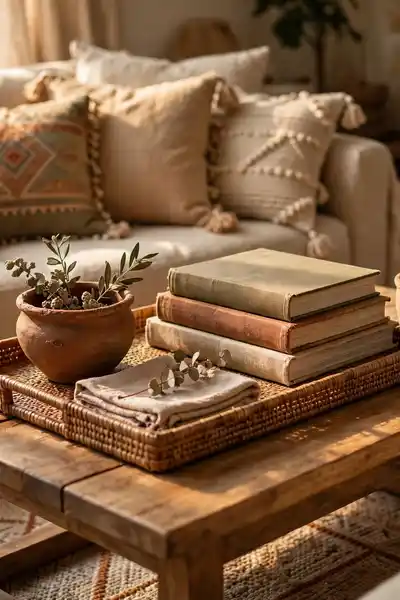
What You Need:
- A low wooden table with a little honest wear
- A tray to hold the everyday things
- Something tall: a vase, a candle, or a small lamp
- Something flat: two or three stacked books
- Something alive: one small plant or a bowl of stones
Build the table in layers: a tray, something tall, something flat, something alive. Change only the alive layer with the seasons and the table always looks freshly styled, while everything a family actually needs stays inside the tray’s honest borders all week in daily life.
A Rattan or Beaded Pendant Light

Before: The ceiling holds one builder grade dome light that flattens everything under it. The seating below looks tired at night, and the room’s whole evening mood dies at the switch by the door.
After: A woven pendant hangs low over the table, its warm bulb patterned by the shade. The seating becomes a pool of light that people gather inside, and the ceiling finally joins the room.
Hang it lower than feels safe on paper, roughly thirty inches over a coffee table, because boho light lives close to the people under it. The shade throws patterned shadows after dark, which is free decoration the room performs every single long evening at home.
Pattern Mixing Without the Clash
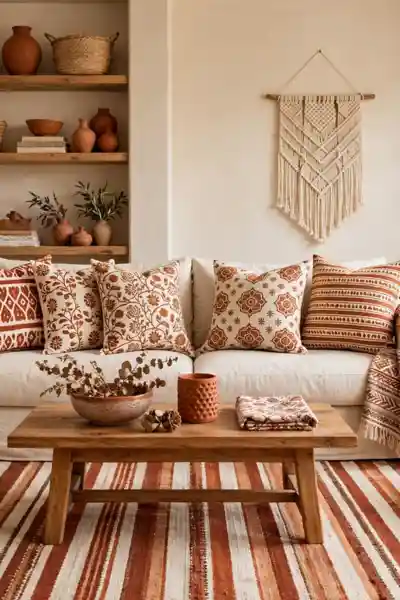
Do This:
- Hold every pattern inside the palette you already set
- Work a scale ladder: one large print, one medium, one small
- Repeat each pattern twice somewhere in the room
- Keep one solid, quiet piece beside every patterned group
Avoid This:
- Mixing palettes along with the patterns
- Placing two prints of the same scale side by side
- Using one pattern only once, so it looks like a mistake
- Choosing shiny fabrics that fight the natural weaves
Work the scale ladder: one large print, one medium, one small, all inside the palette you already set. Repeat each pattern twice somewhere in the room and the mix reads as a decision, which is the entire difference between clash and character in a room.
Linen Curtains Pooled Softly

Cost: Low to mid | Rule: High, wide, and pooled | Best Fabric: Linen or cotton | Result: Softer light, taller walls
Curtains set the room’s softness at its edges, where light enters, so they punch far above their cost. Buy the longest panels the budget allows and let them rest on the floor like they have nowhere else to be, because that is exactly the feeling.
Also Explore: 20 Dreamy DIY Boho Curtains You Can Sew This Weekend
Books, Bowls, and Beads: The Small Finishers

Rooms rarely need one more big thing. They need the small true things: a bowl that holds the shells from one beach, beads with a little weight, books you actually open. Finishers are cheap because they are personal, and personal is the one thing money cannot shortcut.
Finishers are where a room stops being furnished and starts being someone’s. A strand of beads over a book stack, a bowl holding shells from one beach, stones from one walk: small true things, placed slowly, are what guests remember and photographs catch every time.
Boho in a Small or Rented Room
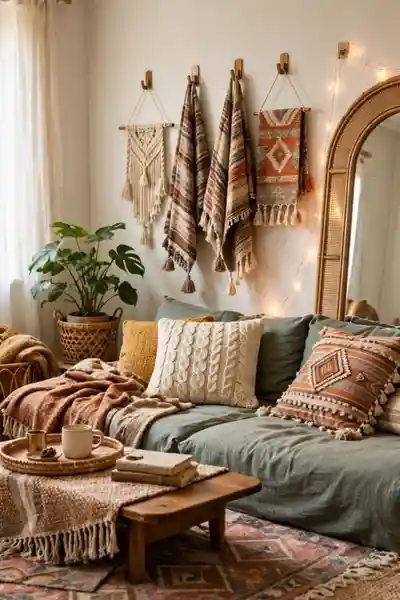
Small rooms take boho kindly, because the style is layers, not furniture. A renter can hang textiles on hooks, lean the mirror, layer the rugs, and keep every piece light enough to carry out alone, which means the whole look can move house in one trip.
- Hang textiles and hangings on removable hooks, never new holes.
- Lean the mirror and large art against walls instead of fixing them.
- Layer rugs freely, since rugs need no permission from anyone.
- Keep every piece light enough to carry out alone at moving time.
Hold the palette tighter than a big room would, and let one wall carry the soul while the rest stay calm. I’ve seen this work well in many cases in studio flats, where a single rug, a draped corner, and three plants did absolutely everything.
The Whole Look on a Small Budget

Quick Tip: Spend first where hands touch: throws, cushions, and the rug under bare feet. Eyes forgive a plain wall for months, but skin notices cheap texture in a single evening, so the comfort layers earn their money before any decoration does.
Set a small monthly amount and hunt slowly, because the hunt is half the style. A room built over six patient months costs a fraction of a weekend shopping spree and carries six months of stories the spree could never put on a shelf at home.
Pick Your Boho: Soft, Modern, or Maximalist
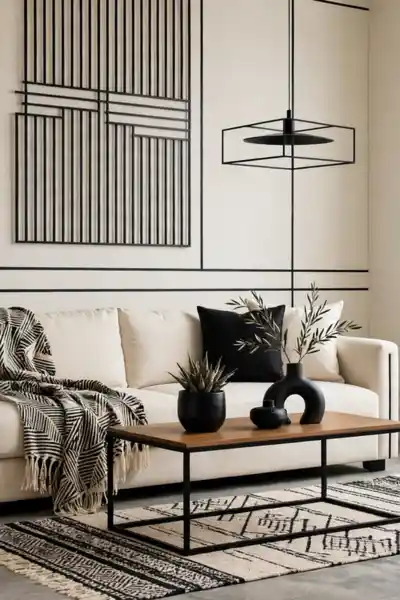
Common Mistake: Drifting between lanes inside one room: a maximalist cushion pile under modern black lines on a soft cream sofa. Each lane is right on its own; together they argue, and the room feels undecided instead of collected.
The Fix: Name your lane out loud, then check every new piece against it before the piece enters the room: temperature first, object second.
None of the three is more boho than the others; they are three temperatures of the same warmth. Choose by your honest energy at home: calm people thrive in soft rooms, tidy people in modern ones, and collectors only ever relax inside their beautiful clutter.
Mistakes That Make Boho Look Messy
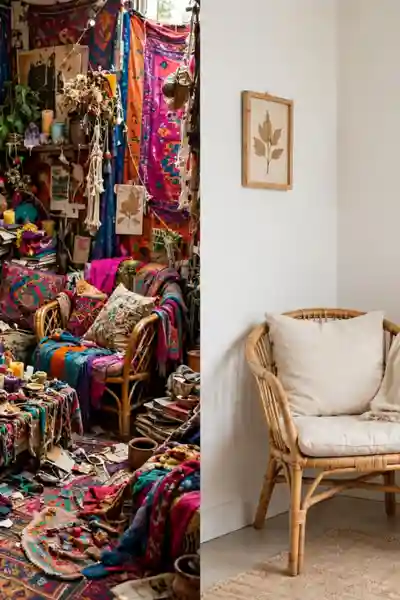
Boho fails in a predictable direction: not too little, but too much, unedited. The same four mess makers appear in almost every cluttered boho room, and happily all four are fixed by editing and light, not by another shopping trip.
- Too many colors at once: cut back to your palette and remove the loudest piece first.
- Every surface covered: clear one whole surface and leave it empty on purpose.
- Fake distressed pieces: swap one of them for a single genuinely old piece.
- Cold overhead light: switch it off after dark and let warm low lamps do the work.
Edit monthly: remove one thing, and let the room breathe before anything new enters. Boho reads as soul when every piece can be seen, and as storage when pieces hide each other, so the fix is rarely buying and almost always subtracting with love and patience.
Frequently Asked Questions
1. Where should I start in a plain, empty feeling living room?
Start with the palette and one rug. Color on the walls’ textiles and a natural rug under the seating change the room’s temperature in a single day, and every later layer has something calm to land on.
2. How many patterns are too many in one room?
Three patterns at three different scales is the comfortable ceiling for most rooms. More can work, but only when every pattern shares the same palette and each one repeats at least twice.
3. Is boho still in style, or is it passing?
The relaxed, natural version keeps outliving trends because it is built from old pieces, plants, and texture rather than a season’s shapes. Rooms styled this way age into themselves instead of dating.
4. Can boho work in a home with kids and pets?
Yes, and it forgives family life better than most styles. Washable covers, jute that hides crumbs, and thrifted pieces you are not precious about make messes feel like part of the room’s story.
5. How do I keep a boho room from looking cluttered?
Edit on a rhythm: one calm wall, clear surfaces between groups, and a monthly removal of one piece. Soul comes from pieces you can actually see, not from how many you own.
Conclusion
Soul was never something a room is bought with. It is layered in slowly, through worn wood, soft textiles, living green, and pieces that carry a past, and these boho living room ideas simply hand you the layers in the order that works fastest.
I’ve seen how small changes like these can completely shift the way a space feels. Save this list on Pinterest before your next thrift run, start with the palette and one rug this weekend, and share it with a friend whose living room feels flat. Your room is closer than it looks.