21 Powerful Home Gym Design Ideas for Small Spaces
Your spare corner is 6 feet wide, the treadmill needs 7, and the gym membership across town keeps winning by default. Small spaces do not need bigger equipment. They need smarter design. These home gym design ideas are built for the room you actually have.
In my experience, small gyms fail from shopping, not from size: one oversized machine arrives, the floor vanishes, and the room becomes storage with guilt attached. Zones first, folding and vertical everything, and training survives in a corner most homes waste.
Inside are 21 ideas in working order: plan the zones, choose gear that earns its footprint, push storage up the walls and doors, then light and style it like a room you enjoy. Tape your zones this weekend and let the rest fall into place.
Measure First: The Three Zones Every Small Gym Needs

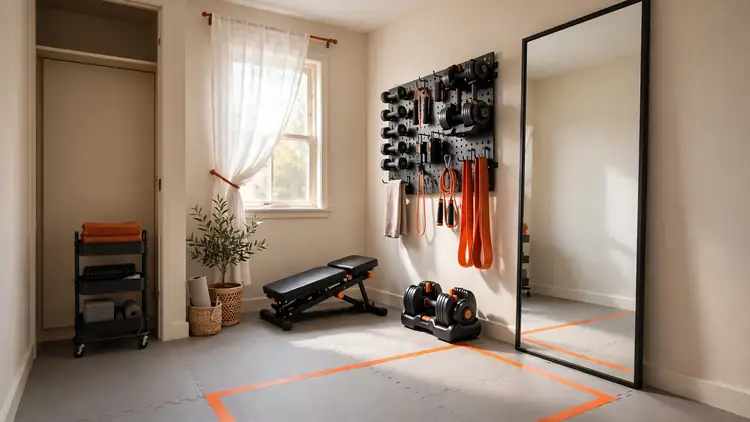
Every small gym that works has the same skeleton: a training zone where you move, a storage zone that swallows the equipment, and a clear walkway between them. Skip the planning and the zones invent themselves, badly, with dumbbells migrating into the walkway by week two.
Measure the room and tape the zones on the floor before buying anything. The training zone needs roughly 6 by 6 feet for mat work and more for a bench. Good home gym design starts with this tape, because every idea in this guide assumes your zones exist and your equipment answers to them.
Choose Equipment That Earns Its Footprint

In a small gym, every piece pays rent in floor space, and most pieces are terrible tenants. The rule that keeps a small gym powerful is simple: if a piece cannot fold, stack, hang, or do two jobs, it does not move in. Apply the rule before emotion shops for you.
- Start with adjustable dumbbells and resistance bands, the most exercises per square foot that exist
- Add a folding bench that stores upright against a wall or under a bed
- Choose one cardio option that folds or hangs: a jump rope, a folding bike, or a door anchor set
- Skip single use machines entirely until the basics have earned a bigger home
Also View: 22 Smart Small Office Ideas for Tight Corners at Home
Wall Mounted Storage That Frees the Floor

Quick Tip: Mount storage at the height of the equipment’s use, not at eye level by habit. Bands and ropes belong beside the anchor point, weights beside the training zone’s edge. Storage placed where the workout happens gets used; storage placed prettily across the room gets walked past.
Wall storage is the single highest return change in a small gym because the floor is your scarcest asset and the walls are free. Two shelves, a rail of hooks, and one rack can hold what used to cover a third of your training zone, and the room breathes again.
A Full Length Mirror That Doubles the Room

Common Mistake: Leaning a loose mirror against the wall behind the training zone, where one bumped dumbbell or one enthusiastic stretch sends it sliding. A leaning mirror in a gym is a countdown, not a design choice.
The Fix: Mount it flat and fixed, with clips or adhesive rated for its weight, at a height where you see your full body from the middle of the training zone. Fixed mirrors never slide, never wobble, and clean in seconds.
Hang the mirror opposite the training zone, not beside it, so one glance checks your whole side profile mid set. In a small room the mirror also bounces window light into the darkest corner, which is half the reason mirrored gyms feel twice their size before you lift anything at all.
Neutral Tones and Sleek Lines That Calm the Space
What You Need:
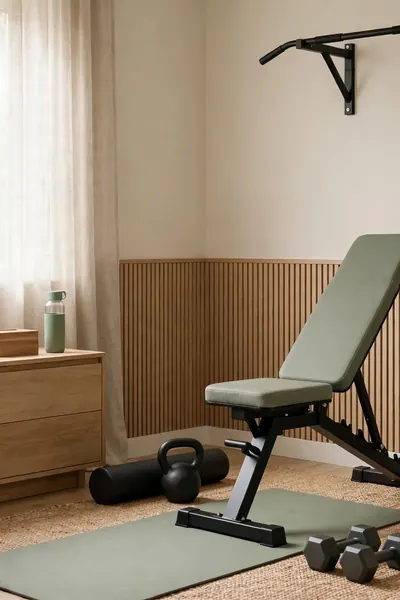
- One wall color in a warm neutral, the same family as the rest of your home
- One floor tone that hides dust and chalk marks between cleanings
- One accent color only, repeated in the mat, the bench pad, and one towel
- Sleek, straight lined furniture with no bulky arms or ornate legs
Limit the palette to three tones at most: one wall color, one floor tone, one accent repeated in the mat, the bench, and one towel. Everything else, hide or match. A small gym in one calm palette reads as a designed room; the same gym in nine colors reads as storage.
A Folding Mat Corner That Sets Up in Seconds

Before: The mat lives rolled behind the sofa, and every session starts with furniture moving and motivation leaking. By the time the floor is ready, the workout window has quietly closed twice this week already.
After: One corner belongs to the mat permanently: it stands folded against the wall beside its basket of bands and blocks. Setup is ten seconds of unfolding, and the corner looks styled, not stored, between sessions.
The corner works because it asks for nothing: no furniture moved, no room surrendered, just a mat that unfolds where you already stand. Corners are the most wasted square footage in small homes, dead at both ends of every day. A mat corner claims one for the strongest habit you own.
Greenery That Makes You Want to Show Up

Do This:
- Hang planters on the wall above storage, where green shows but floor stays clear
- Pick forgiving plants: pothos, snake plant, and ZZ plant survive busy owners
- Put one tall plant in the room’s dead corner to soften the equipment’s hard lines
Avoid This:
- Floor plants inside the training zone, anywhere near a swinging kettlebell
- Delicate plants that need daily misting in a room you enter twice a day
- Fake dust traps on open shelves beside the fan
Keep every plant out of the training zone’s swing and drop radius; a kettlebell arc is no place for a fern. Wall planters and a tall plant in the dead corner give you the green without the risk. Choose plants that forgive missed waterings, because workout corners get forgotten between sessions.
Storage Furniture That Works Two Jobs
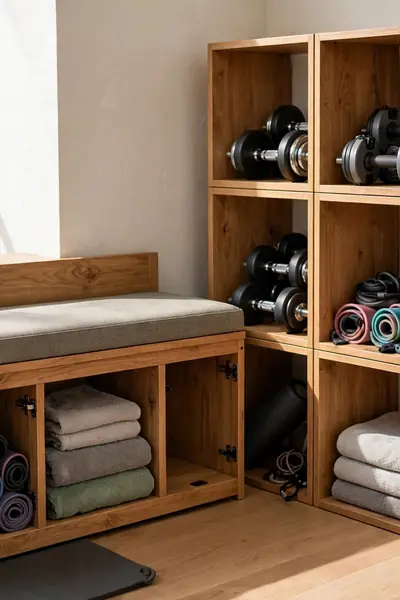
Time Needed: one shopping trip | Difficulty: Easy | Cost: less than a dedicated rack | Result: seating, storage, and a step platform in the same footprint
Measure the furniture’s storage with your actual equipment before buying: dumbbells are longer than product photos suggest, and a bench that swallows bands but not weights solves half your problem. Cubes sized 13 inches fit most gear and stack safely to four high without wobbling.
Flooring That Protects Joints and Floors

Flooring is the layer everyone skips and everyone regrets. Bare hard floors punish joints, echo through the building, and take dents from the first dropped dumbbell. Interlocking foam or rubber tiles fix all three for the price of a single month at a commercial gym across town.
Cut tiles to the training zone only, not wall to wall; a defined floor island sharpens the zone and saves a third of the cost. Keep one spare tile in the closet, because the tile under the heaviest traffic always wears first and a single swap refreshes the whole floor.
Hidden Storage Inside Furniture You Own
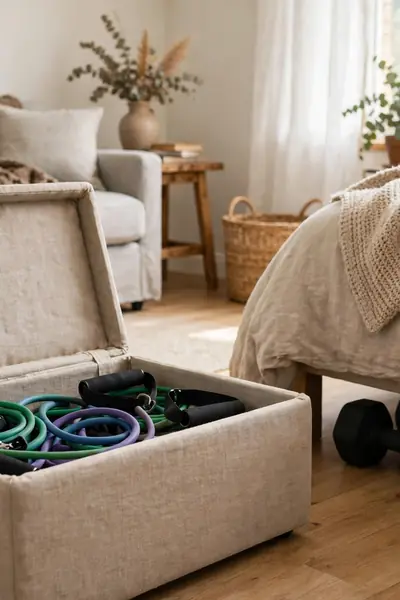
The best small gym storage is the furniture already standing in your home, doing one job and hiding a second. An ottoman, a bed frame, a sofa’s dead back space: each one can swallow a full workout kit without the room ever announcing it is a gym.
- Open the ottoman first: bands, gloves, towels, and the jump rope live there, sorted in one small bin
- Slide flat gear under the bed or sofa: the folding bench, sliders, and the spare mat
- Hang the heaviest daily items on the storage wall, because hidden storage you dread opening stops being used
- Keep one visible basket for today’s session only, so the room returns to calm every night
A Room That Shares: Gym by Morning, Office by Day
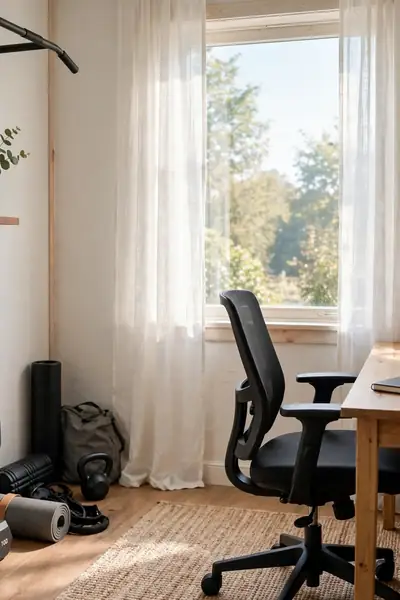
Quick Tip: Convert the room the night before, not in the groggy five minutes before a morning session. A gym that is already set up when the alarm rings gets used; a room that needs ten minutes of furniture shuffling first gets negotiated away by a sleepy brain.
Set a closing ritual: five minutes where the room converts back, bench folded, mat rolled, weights racked, floor clear. Rooms that convert on a ritual stay shared happily for years. Rooms that convert when someone complains become a second bedroom with gym equipment resented inside it, which helps nobody.
Also Explore: 20 Inspiring Office Decorating Ideas to Boost Focus
Motivational Wall Art That Pulls You In

Common Mistake: Covering every wall with small posters, quotes, and race bibs until the room buzzes. In a small gym that visual noise competes with the mirror and the equipment, and the space feels smaller and more frantic than before the decorating started.
The Fix: Choose one wall, one large piece, one message. Let it be the only loud thing in the room, placed where your eyes land during the hardest sets, so it works as a coach and not as wallpaper.
Keep art to one wall and one message family: your goal, your sport, or your finish line. A single oversized print beats five small ones in a small room, where every frame edge is visual noise competing with mirrors and equipment. Read it from the training zone, not the doorway.
A Towel Station That Keeps It Tidy

What You Need:
- One wall mounted towel rack or rail, sized for two towels side by side
- Two hooks beside it, for the towel in use and a sweat towel
- A small lidded hamper at the station’s base, for used towels
- A simple rotation: two towels out, two in the wash, two folded in reserve
Position the station at the training zone’s edge, on the way out of the room, so used towels land in the hamper as you leave. A towel system placed across the room fails by Friday; one placed on your exit path runs itself for years without a single reminder.
Compact Seating That Folds Away

Before: A bulky armchair squats in the corner full time so someone can sit for ninety seconds of shoe tying and rest breaks. The gym’s second biggest footprint serves its smallest job, and the training zone bends around it daily.
After: A sturdy folding chair hangs flat on a wall hook, opens in seconds when a seat is needed, and vanishes after. The corner returns to training, and the seat appears exactly when, and only when, it earns its floor time.
Choose chairs rated for real weight and real sitting, not garden furniture pressed into service. A folding chair that flexes during seated presses is a hazard wearing a space saving costume. Test the wobble in the store; your future self under a dumbbell will thank you.
A Small Sound Setup That Fills the Room
Do This:
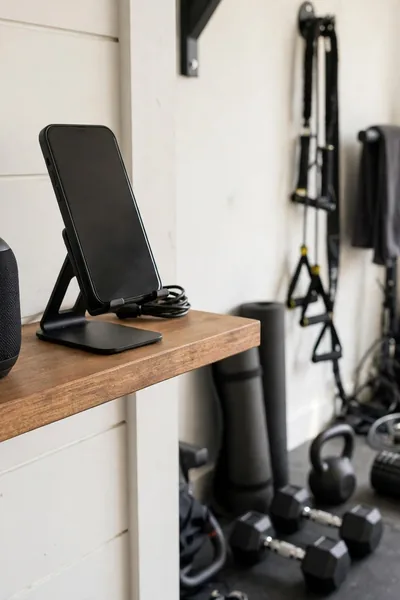
- Set one good small speaker at ear height on the storage shelf
- Keep a phone stand beside it, so timers and videos stay visible hands free
- Agree a household volume ceiling for early sessions and honor it
Avoid This:
- A speaker on the floor in the corner, where sound muddies and volume climbs
- Earbuds for heavy lifts, where a snagged cable changes a lift’s ending
- Blasting through shared walls at dawn to feel motivated
Set the speaker at ear height when standing, on the storage shelf, pointed across the training zone. Sound thrown from a corner at ankle height muddies and forces the volume up. Ear height and across the room gives full sound at half the volume, which your household will notice.
A Fold Down Desk for Workouts and Work
What You Need:
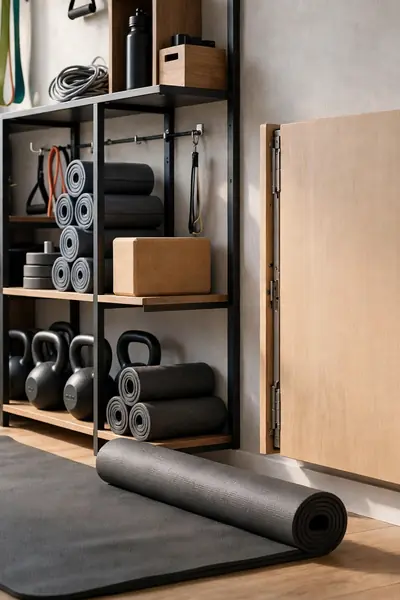
- One wall mounted fold down desk rated for laptop weight plus leaning forearms
- Stud mounting hardware; this desk takes real downward force and must anchor properly
- A wall spot at standing height, clear of the training zone’s swing space
- One slim chair or stool that hangs or folds when the desk is up
Mount the desk on the wall opposite the storage, at standing height for laptop work and video calls between sessions. When it folds up, its underside becomes the room’s blank panel, which is where a second mirror or the art print can live. One wall, three jobs, zero floor.
Soft Layered Lighting for Early Sessions

Time Needed: one bulb swap and one lamp | Difficulty: Easy | Cost: Low | Result: a gym that feels furnished at 5 AM, not like a garage
Layer one bright overhead option for form checks with one warm low lamp for early sessions and stretching. Single source lighting is why small gyms feel like garages. Two sources at two heights make the same square footage feel furnished, and the warm layer is the one guests compliment.
Door Mounted Storage and a Pull Up Bar

The back of a door is a full storage wall that most homes leave blank. A rated over door rack holds bands, towels, a jump rope, and light dumbbells where they vanish the moment the door closes. In a rented room, it is storage that asks nobody’s permission.
A doorway pull up bar, the kind that braces on the frame without screws, turns that same door into the gym’s power station. Check the frame’s condition first and respect the bar’s weight rating honestly. One doorway then does storage, pulling, and band anchoring in a single square foot.
A Rolling Cart Gym That Parks in a Closet

A closet and a cart together do what a spare room does for richer houses: they hold an entire gym invisibly. The cart is the room, on wheels, and the closet is its garage. Park it loaded and the workout lives wherever the floor is free.
- Load heavy on the bottom shelf: dumbbells and the kettlebell ride low for stability
- Middle shelf takes bands, gloves, towels, and the jump rope, each in its own small bin
- Top shelf stays for the day’s session only: water, phone stand, and today’s tools
- Measure the closet doorway before buying the cart, twice, because returns are nobody’s hobby
Keep the cart’s heaviest items on the bottom shelf and its daily items on top, so the morning grab takes seconds. A cart that needs unpacking to reach the good gear becomes furniture by week three. Loaded right, it rolls out, serves the session, and rolls home in under a minute.
Adjustable Dumbbells: One Pair, a Whole Rack

Store the pair on their cradle in the storage zone, never loose on the floor mid room. Adjustable sets concentrate serious weight in a small footprint, which is their genius and their only danger. Cradle parked, dials checked, and the heaviest tool you own behaves like a shoebox.
A Resistance Band Anchor Wall

Common Mistake: Anchoring bands to a door handle, a shelf edge, or a piece of furniture and trusting it. Bands store serious energy, and an anchor that lets go mid row returns that energy toward your face at speed. Improvised anchors are how band workouts end early.
The Fix: Screw a proper anchor plate or heavy duty strap anchors into wall studs at ankle, chest, and overhead heights. Test each anchor with a hard two handed pull before the first real set, and inspect bands weekly for nicks near the handles.
A resistance band set costs less than one dumbbell and trains every muscle you own, but only if the bands anchor to something that will never move. A wall anchor plate, screwed into a stud at three heights, turns one blank wall into a cable machine that takes zero floor.
Ceiling and Vertical Space Nobody Uses
What You Need:
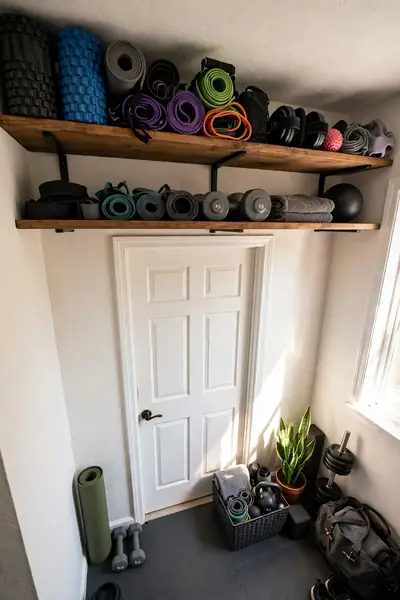
- One or two high shelves rated for the load, mounted into studs above the door line
- Light gear only for the top: foam rollers, spare bands, yoga blocks, empty storage bins
- A sturdy step stool that itself folds or hangs flat
- Labels on bin fronts, so the top shelf stays a system, not a mystery
Mount the high shelf above the door or along the room’s least used wall, and store by frequency, not by category. The foam roller and spare bands live up top; daily gear never does. Anything stored overhead must also be light, because nobody needs a dumbbell’s worth of motivation falling.
A Shoe Bench Entry Zone That Catches the Mess
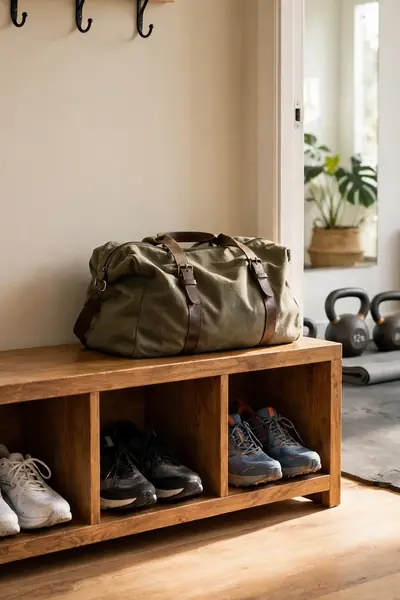
Before: Shoes pile where they were kicked off, the gym bag migrates into the training zone, and street dirt rides in on every sole. The gym’s edge dissolves a little more each week until the whole room feels like a hallway with weights.
After: One bench at the threshold catches everything at the border: shoes under, bag on top, a hook above for the towel. The room’s inside stays clean, ordered, and visibly a gym from the doorway.
Place the bench where you enter, not where you train, because its job happens at the door: sit, shoes on, bag down, phone charging. Ninety seconds of ritual at the threshold keeps street shoes, street dirt, and scattered kit on the right side of the room’s border.
Mistakes That Shrink a Small Gym Further
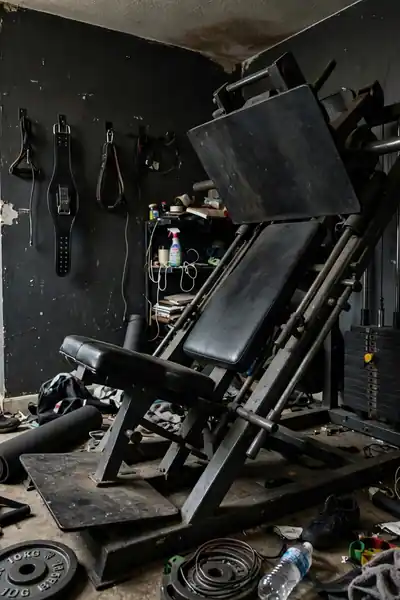
Do This:
- Audit the room monthly and remove anything that has not been used in 30 days
- Keep the training zone sacred: nothing stores there, not even overnight
- Buy storage before equipment, so every new piece arrives to a home
Avoid This:
- One oversized single use machine bought on a January promise
- Dark paint and heavy curtains in a room already short on light
- Letting laundry, parcels, and household overflow colonize the corners
The pattern underneath all five is the same: a small gym fails by addition, not by size. Every unplanned object steals from the training zone, and the zone is the whole point. Guard the floor, audit monthly, and let each new thing argue its way in or stay in the store.
Frequently Asked Questions
1. How much space do I actually need for a home gym?
Less than most people think. A clear 6 by 6 foot training zone handles mat work, dumbbells, bands, and a folding bench, which covers most full body training. If you can stand with arms stretched wide and turn in a full circle without touching anything, you have enough room to start.
2. What equipment should a small gym start with?
Start with the highest exercise count per square foot: one pair of adjustable dumbbells, a set of resistance bands with a proper wall or door anchor, a folding mat, and a jump rope. That kit trains every muscle group, stores inside one cart or cube unit, and costs less than a single large machine.
3. How do I protect my floor and my downstairs neighbors?
Interlocking rubber or foam tiles over the training zone absorb both dents and sound. Under a bench or rack, add a second layer where weights get set down. Schedule heavy sessions for reasonable hours, and never drop weights in an apartment if you can set them down instead; your floor and your relationships both last longer.
4. Can I build a good gym in a rented room without drilling holes?
Yes. Over door racks and doorway pull up bars need no screws, storage cubes and carts need no fixing, and leaning mirrors can be secured with removable adhesive strips rated for their weight. The only items that truly need studs are wall anchor plates and heavy racks, and both have door mounted alternatives that work nearly as well.
5. How do I keep a shared room from slowly turning back into storage?
Zones and a closing ritual. Tape or tile the training zone so its border is visible, keep a five minute reset after every session, and audit the room once a month: anything that has not been used in 30 days leaves. Shared rooms fail by slow addition, not by one big mistake.
6. What is a realistic budget for a small home gym?
A strong starter version, adjustable dumbbells, bands with anchors, a mat, tiles for the training zone, and one storage cube, usually lands between $250 and $450 depending on the dumbbell range you choose. Add pieces one at a time after that, buying storage before equipment so every new item arrives to a home.
Conclusion
Your small space was never the problem. Unplanned space was. With zones taped, storage on the walls, and gear that folds, stacks, or anchors, home gym design turns a spare corner into the most used room in the house. I’ve seen how small changes like these can completely shift a workout habit. Save this guide on Pinterest before your setup weekend, start with the tape and the zones, and share it with a friend whose dumbbells still live in the hallway. Your strongest room is the one you already have.





One Comment